EDR Logs and Alerts: How to Monitor and Respond to Endpoint Threats
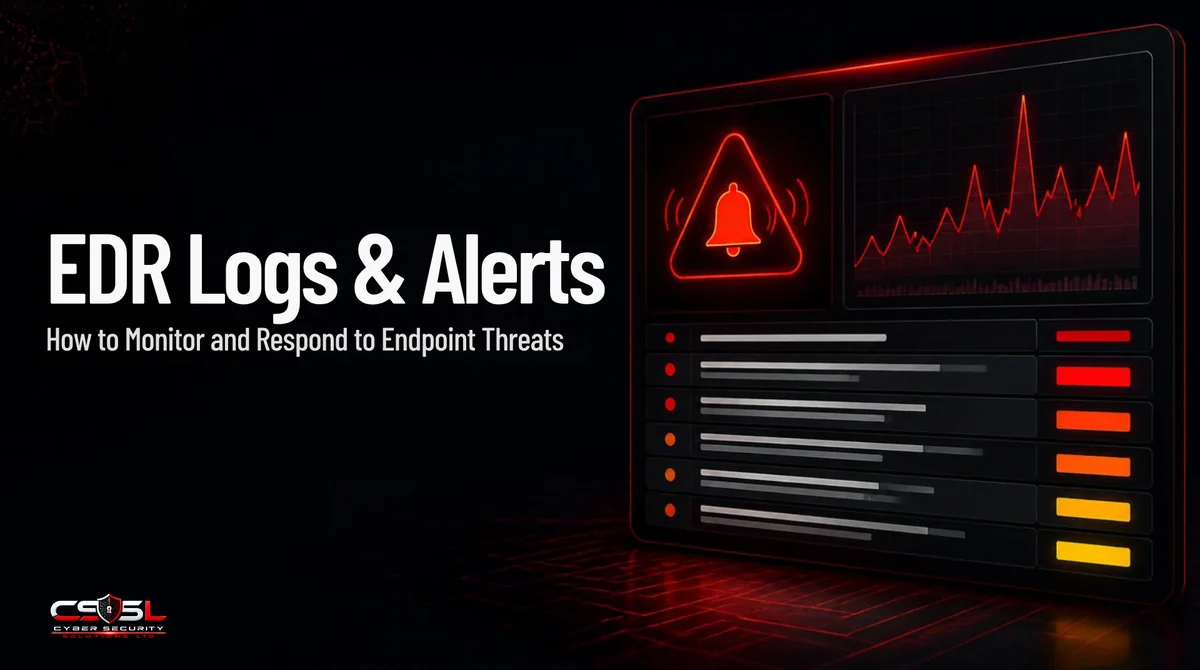
EDR logs and alerts aren’t the same thing, and treating them identically is why most businesses either overpay for storage or drown their team in noise. Logs are the raw, continuous record. Alerts are the flagged subset someone actually needs to act on. Get that distinction right and everything downstream, retention, severity, response, gets genuinely manageable.
What are EDR logs and alerts, and why do they need different treatment?
EDR logs are the continuous, raw telemetry stream, every process, file change, and network connection an endpoint generates. EDR alerts are the flagged subset the platform’s detection logic surfaces as potentially malicious, requiring human review. Storing and triaging both the same way wastes budget on one and buries analysts under the other.
The volume gap between the two is enormous: a single endpoint can generate thousands of raw log events daily, while only a small fraction ever triggers an actual alert. This is exactly why the storage strategy and the response strategy need separate frameworks, one optimized for cost-efficient bulk retention, the other for fast, accurate human decision-making, covered in the next two sections.
How long should you keep this data? Hot, warm, and cold storage explained
Log retention should split into three tiers: hot storage (0 to 90 days) for active investigation at $0.25 to $1.50 per GB monthly, warm storage (90 days to 12 months) at $0.03 to $0.10 per GB monthly, and cold storage (beyond 12 months) as cheap object storage for compliance archival.
| Tier | Retention Window | Cost per GB/Month | Use Case |
|---|---|---|---|
| Hot | 0-90 days | $0.25-$1.50 | Real-time correlation, active investigations |
| Warm | 90 days-12 months | $0.03-$0.10 | Investigation queries, slower but usable |
| Cold | 12 months+ | Under $0.03 | Compliance archival only |
This tiering matters because paying hot-tier prices for data you’ll rarely query again is a genuinely common, avoidable cost. Hot storage delivers full interactive query speed for active incidents, but at 10 to 15 times the per-GB cost of cold archival, so any log source you’re keeping purely for compliance rather than active detection belongs in warm or cold tiers, not hot. Compliance frameworks like PCI DSS, HIPAA, and SOC 2 each specify different minimum retention periods, so map your retention plan to the specific framework requirements you’re actually subject to, rather than defaulting to “keep everything in hot storage indefinitely,” which is the single most common way log retention costs spiral out of proportion to the actual investigative or compliance value being retained.
Building alert tiers that don’t drown your team: a practical framework
Most industry frameworks use four severity tiers, Critical, High, Medium, Low, but a team without dedicated SOC staff genuinely benefits from collapsing this into three actionable tiers: act now, act today, and batch review weekly.
| Practical Tier | Maps To | Response Target |
|---|---|---|
| Act now | Critical + High | Immediate investigation |
| Act today | Medium | Same business day |
| Batch review | Low + Informational | Weekly review |
A representative real-world alert distribution shows why this collapse matters practically: in one documented SOC month, critical alerts made up just 1.5% of total volume, high 10%, medium 40%, and low 48.5%, with only 20% of all alerts confirmed as true positives and 60% false positives. For a team without the staffing to maintain four distinct response workflows, collapsing medium-through-low into a scheduled weekly batch review, rather than treating every tier as requiring same-day attention, keeps the “act now” and “act today” categories genuinely fast while preventing the lower tiers from silently piling up unreviewed. The textbook four-tier model works well for a staffed SOC. The three-tier collapsed version is what actually gets followed consistently by a smaller team.
Why teams end up disabling alerts entirely, and how to avoid it
Teams disable noisy alert types not out of carelessness but as a rational, exhausted response to sustained false positive volume, and it’s a well-documented failure mode directly tied to missed real incidents, not a hypothetical risk.
The pattern is consistent and predictable: an alert type fires repeatedly with the same benign cause, an analyst investigates it dozens of times without finding a genuine threat, and eventually either mutes the rule entirely or starts reflexively dismissing it without review, the exact moment a genuine instance of that alert type would slip through unnoticed. This isn’t a training problem, it’s what sustained, unmanaged noise does to any human reviewing the same false alarm repeatedly. The structural fix isn’t “pay closer attention,” it’s addressing the noise at its source: tune or suppress the specific condition causing repeated false positives, document why, and track which alert types get muted and by whom, so a disabled rule is a deliberate, reviewed decision rather than a quiet, undocumented workaround nobody remembers making six months later. Before assuming your team would never do this, audit your current alert configuration for any rule with an unusually low alert volume relative to your endpoint count, since that’s often the first sign a noisy rule got silently suppressed rather than properly tuned.
What does raw EDR alert data contain?
A typical EDR alert includes the triggering event, affected host and user identity, a process tree showing parent-child execution relationships, relevant file paths or registry keys, network connections involved, and a severity score assigned by the platform’s detection logic.
This structure matters because the process tree specifically is what separates useful alert data from a bare notification: seeing that a suspicious executable was launched by a legitimate parent process, like a phishing document spawning PowerShell, tells an analyst far more about intent than the flagged process alone would. Most modern EDR platforms also attach a confidence or severity score based on how closely the observed behavior matches known attack patterns, giving triage staff a starting point for prioritization even before manual review begins.
UEBA and behavioral baselines: catching what static rules miss
UEBA, User and Entity Behavior Analytics, establishes a behavioral baseline for each user and device over a typical 60 to 90 day learning period, then flags deviations from that baseline, catching threats static, rule-based detection structurally can’t see, like a compromised but valid account behaving unusually.
UEBA and EDR are complementary rather than overlapping: EDR monitors and responds at the individual endpoint level, while UEBA monitors behavior patterns across the entire network, including but not limited to endpoints. A rule-based EDR alert fires when it matches a known bad pattern. UEBA fires when behavior deviates from what’s normal for that specific user or entity, catching scenarios like a legitimate account suddenly accessing systems it’s never touched before, activity a static rule would never flag since nothing about the login itself looks malicious. Organizations using behavioral analytics reported saving an average of $5.1 million annually on insider risk costs in a 2026 Ponemon Institute study, reflecting how much earlier this approach catches compromised-but-valid-credential activity compared to signature or rule-based detection alone.
The current tools automating this, and how to choose between them
Automated AI-driven alert triage tools can reduce analyst workload by 80% or more, autonomously enriching, scoring, and closing benign alerts while escalating genuine threats with supporting evidence, without requiring a human to manually review every alert first.
Organizations deploying AI triage tools commonly report 60% to 90% reductions in false positive volume reaching human analysts. Current platforms handle 80% to 90% of routine, pattern-matching alerts autonomously, explicitly positioned to augment rather than replace human judgment for novel or ambiguous incidents. When choosing between tools, prioritize explainability specifically, ask whether the platform shows its reasoning for each closed or escalated alert, since a black-box triage system that closes alerts without a documented rationale creates its own audit and trust problem down the line. Named platforms in this category include Microsoft Security Copilot’s specialized triage agents, Vectra, and Swimlane, each varying in how deeply they integrate with existing SIEM and EDR investments versus requiring a broader platform commitment.
A worked example: one alert, tier by tier
Consider a real-shaped scenario: an EDR alert fires showing PowerShell launched from a Microsoft Word process on a finance department laptop, with a network connection to an unfamiliar external IP immediately after.
The platform’s detection logic assigns this High severity based on the suspicious parent-child process relationship, a classic phishing indicator. Under the three-tier framework covered earlier, this lands in “act now.” The analyst reviews the process tree, confirms the document was opened minutes earlier from an email attachment, and checks the external IP against threat intelligence, finding it flagged as a known command-and-control server. The alert gets escalated to full incident response: the endpoint is isolated, the user’s credentials are reset, and the finding gets documented with a clear timeline. This is what “act now” tier response looks like in practice, fast triage, evidence-based escalation, and documentation sufficient to support any downstream compliance reporting obligation, including structured incident disclosure requirements for regulated organizations.
A realistic setup if you’re not running enterprise-scale log volume
Start with a simple two-tier storage split, 90 days hot for active investigation, everything older moved to cheap cold archival, rather than building a full three-tier pipeline before your log volume genuinely justifies the added complexity.
Pair that storage simplification with the three-tier alert framework covered earlier, act now, act today, batch weekly, and commit to documenting any alert rule you mute or suppress, even informally, so tuning decisions stay visible rather than silently accumulating. Cyber Security Solutions Ltd helps smaller clients set up exactly this simplified two-tier storage and three-tier alert structure, since it delivers most of the cost and workload benefit of a full enterprise pipeline without requiring the staffing an enterprise setup assumes. Expand toward the fuller hot-warm-cold model only once your actual log volume and compliance obligations genuinely require the added granularity.
Conclusion
EDR logs and alerts only work as a defense system when storage and triage get treated as separate problems, cost-tiered retention for the logs, a genuinely followable severity framework for the alerts. Start simple, document every tuning decision, and expand complexity only once your volume actually demands it. If you want help setting up a retention and triage structure that fits your team’s real capacity, Cyber Security Solutions Ltd can walk through it with you at cybersecuritysolutionsltd.com.
FAQs
EDR logs are the continuous, raw telemetry stream every endpoint generates, process activity, file changes, network connections. EDR alerts are the flagged subset the platform's detection logic surfaces as potentially malicious, requiring human review. Logs need cost-efficient storage; alerts need fast, accurate triage.
Use a tiered approach: hot storage for 0 to 90 days for active investigation, warm storage for 90 days to 12 months for slower queries, and cold storage beyond 12 months for compliance archival. Map retention length to your specific compliance framework requirements, not a blanket policy.
A false positive is an alert the EDR platform flags as potentially malicious that turns out to be benign upon investigation. Industry data shows false positives commonly account for 40% to 60% of total alert volume, a major driver of analyst fatigue and, eventually, disabled alert rules.
It's a three-tier retention model balancing cost against query speed. Hot storage offers fast, full-query access at higher per-GB cost for recent, active-investigation data. Warm storage costs less with slower queries. Cold storage is the cheapest tier, reserved for long-term compliance archival.
Start with three practical tiers rather than a full four-tier academic model: act now for critical and high severity, act today for medium, and batch weekly review for low and informational alerts. This collapsed structure stays consistently followed by teams without dedicated SOC staffing.
UEBA, User and Entity Behavior Analytics, establishes a behavioral baseline for users and devices over roughly 60 to 90 days, then flags deviations from that baseline. It catches threats static, rule-based EDR detection misses, like a compromised but valid account behaving unusually.
AI-driven triage tools can reduce analyst workload by 80% or more, autonomously enriching, scoring, and closing benign alerts while escalating genuine threats with supporting evidence. Choose platforms that show explainable reasoning for each decision, since black-box triage creates its own audit gap.