What is EDR as a Service and When It Makes Sense
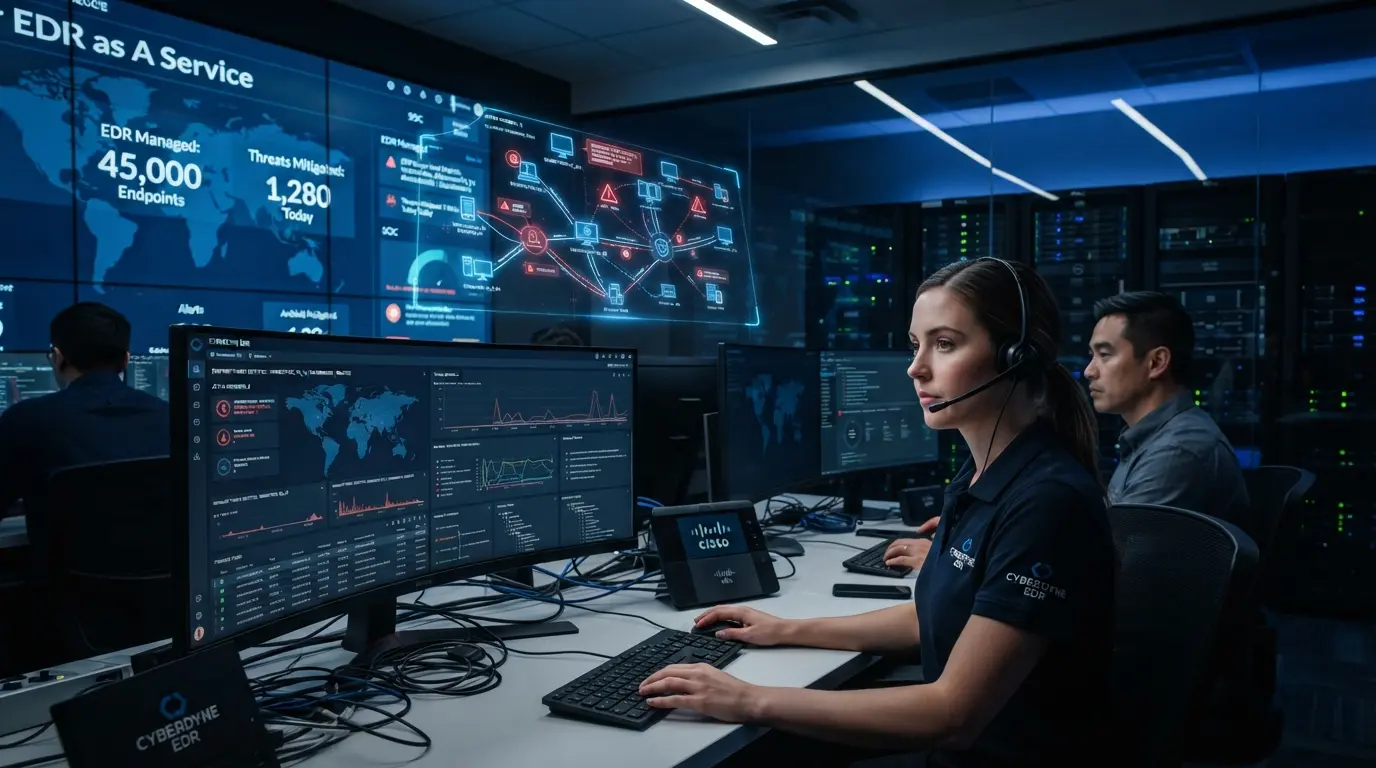
EDR as a service delivers endpoint detection and response through a cloud-hosted, subscription model, with the provider managing infrastructure, updates and often monitoring, rather than your team running the platform yourself. If you have assumed this is simply EDR software with a subscription price tag, the real distinction goes considerably deeper than pricing alone.
What Is EDR as a Service?
EDR as a service delivers endpoint detection and response capability through a cloud-hosted platform the provider operates and maintains directly, rather than infrastructure your own team deploys and manages on-premises. The subscription typically covers the platform itself, ongoing updates, and often a defined level of monitoring or support.
This differs meaningfully from simply purchasing EDR software under a subscription license, since the service model shifts genuine operational responsibility, infrastructure maintenance, platform updates, scaling, away from your own team and onto the provider directly.
How Is This Different From Buying and Running EDR Software Yourself?
Self-managed EDR requires your own team to handle deployment, ongoing tuning, infrastructure scaling and ongoing platform maintenance, even when the underlying software itself comes from a commercial vendor. EDR as a service removes these specific operational burdens, since the provider hosts and maintains the platform directly.
The genuine trade-off worth understanding directly: self-managed EDR typically offers deeper configuration control, since your team directly manages every setting. EDR as a service trades some of that granular control for considerably reduced operational overhead, a genuinely reasonable exchange for organizations without dedicated capacity to manage infrastructure themselves.
What Does Moving From Self-Managed to As-a-Service Involve?
Migrating from a self-managed deployment involves exporting existing configuration and historical data where possible, deploying the provider’s own agent across your endpoints, and decommissioning your previous infrastructure once the new service is confirmed operational. This is rarely a simple flip of a switch.
Plan for a genuine transition period where both systems may run in parallel briefly, confirming the new service captures equivalent coverage before fully retiring your previous setup. Budget real time for this transition specifically, since rushing it risks a genuine coverage gap during the switch itself.
Can EDR as a Service Be Bundled With Backup and Disaster Recovery?
Yes, and this represents a genuinely distinct delivery model worth understanding directly, not simply a marketing bundle. Acronis Cyber Protect illustrates this precisely, combining backup and disaster recovery capability with EDR and anti-malware protection within one integrated platform, rather than treating these as entirely separate purchases from separate vendors.
This integration offers genuine practical value beyond simple convenience. When ransomware specifically targets both production data and connected backup systems, a platform combining detection and backup protection within one unified service can coordinate response more directly than two entirely separate tools ever could, since the backup and detection layers share awareness of the same incident in real time. Choosing a bundled platform makes particular sense for organizations wanting one vendor relationship covering both prevention and recovery, rather than managing separate contracts, separate support channels and separate consoles for what functions as one coherent protection strategy during an actual incident. The trade-off worth weighing honestly: a bundled platform may not match a dedicated, single-purpose EDR vendor’s own detection depth specifically, since the provider is genuinely balancing capability across two distinct disciplines rather than focusing entirely on one.
MDR vs MSSP: Getting the Terminology Straight
| MDR | MSSP | |
| Focus | Detection and response specifically | Broad security service portfolio |
| Origin | Newer, focused category | Older, established umbrella term |
| Typical scope | EDR/XDR-centered monitoring | Firewalls, patching, general management |
MDR, Managed Detection and Response, is a genuinely focused service category built specifically around continuous monitoring and response using EDR or XDR technology as its core. MSSP, Managed Security Service Provider, is the broader, older umbrella term covering a wider portfolio of outsourced security services, firewall management, patching, general security administration, that may or may not include genuine detection and response capability at all.
This distinction matters directly when evaluating a provider claiming to offer EDR as a service. An MSSP relationship might include EDR as one component among many broader services. An MDR relationship centers specifically on detection and response as its core offering. Confirm directly which category a specific provider genuinely fits before assuming their broader security service portfolio automatically includes the focused, continuous EDR monitoring capability an MDR relationship specifically provides.
What Does This Cost? Real UK Government Pricing
UK public sector organizations procure EDR as a service through G-Cloud, now in its 14th iteration, via pre-priced listings on the Public Procurement Gateway, formerly known as the Digital Marketplace. This model lets buyers place call-off orders directly at the supplier’s own listed price, with no further negotiation required for orders under £20,000.
Genuine, current WithSecure EDR listings on this platform, offered through named resellers, specify real, concrete service terms worth understanding directly: a 99.9% availability SLA with prorated service credits if that target is missed, tiered support response commitments, Severity 1 incidents addressed within one hour, Severity 2 within four hours, and hosting through Tier 4 data centres offering high resilience. This illustrates precisely what “real government pricing” actually means in practice: not a single universal figure, but pre-published, binding service commitments any public sector buyer can review directly before purchasing, considerably more transparent than typical private-sector vendor quoting processes requiring individual sales negotiation. Over the past five years, G-Cloud has facilitated £14.72 billion in total sales, with SMEs representing over a third of that volume, confirming this procurement route genuinely serves smaller suppliers and buyers alike, not only large enterprise vendors and contracts.
Is This Right for a Small Business, or Only Larger Organisations?
EDR as a service genuinely suits smaller organizations specifically well, since it removes the infrastructure management burden that makes self-managed EDR impractical without dedicated technical staff. A small business gains access to the same underlying detection technology larger organizations use, without needing to build the internal capacity to host and maintain it directly.
Larger organizations with existing dedicated infrastructure teams may find self-managed deployment offers genuine configuration control worth retaining, though many still choose the service model specifically to free that internal capacity for other priorities instead.
A Practical Framework for Choosing Pure EDR vs a Fully Bundled Service
Choose pure EDR as a service if you already have separate, working backup and disaster recovery arrangements you are satisfied with, avoiding unnecessary duplication of capability you already have covered elsewhere. Choose a bundled platform specifically if you are building your security stack from a genuine starting point, or want the coordinated incident response advantage covered earlier when ransomware targets both production and backup systems simultaneously.
Confirm directly whether a prospective provider genuinely fits the MDR category or the broader MSSP umbrella before assuming detection depth matches your specific needs. Cyber Security Solutions Ltd helps businesses weigh exactly this decision against their existing infrastructure and internal capacity, since neither pure EDR nor a bundled platform is automatically the better choice regardless of what a specific organization already has in place.
Conclusion
EDR as a service genuinely removes operational burden self-managed deployment requires, and whether pure EDR or a bundled backup-and-recovery platform fits better depends entirely on what your organization already has covered elsewhere. Start by confirming whether a prospective provider genuinely offers focused MDR capability or a broader MSSP portfolio. To evaluate the right EDR delivery model for your business, visit cybersecuritysolutionsltd.com for expert support from Cyber Security Solutions Ltd.
FAQs
Yes, with real limitations. Wazuh performs genuine endpoint detection, file integrity monitoring, rootkit detection and active response, qualifying as real EDR-adjacent technology. Its detection depth relies more on configurable rules than the deep behavioral machine learning commercial platforms provide.
No, not currently. Wazuh’s Indexer runs on OpenSearch, the Apache 2.0 fork AWS created after Elastic changed its own licensing in January 2021. Some legacy documentation still references direct Elastic Stack integration reflecting shared technical ancestry.
Start with a single-node Docker deployment, installing the Wazuh Agent on two or three devices first. Confirm alerts flow correctly into the Dashboard before expanding coverage, and budget genuine time for rule tuning beyond the default configuration.
Detection depth compared to commercial EDR, steep setup complexity requiring real Linux and OpenSearch familiarity, and no dedicated vendor threat intelligence feed. Its effectiveness depends heavily on ongoing personal tuning rather than working well immediately after installation.
Cyber Essentials’ malware protection requirement doesn’t mandate EDR specifically at any tier, so Wazuh genuinely exceeds the baseline. Certification still depends on proper configuration and documented evidence, not simply having the tool installed somewhere in your environment.
Pairing helps close specific gaps. osquery adds flexible, ad hoc system querying, while Velociraptor adds deeper forensic investigation capability for active threat hunting, complementing Wazuh’s continuous baseline monitoring rather than duplicating it.