How to Build Cloud Security Strategy That Works in 2026
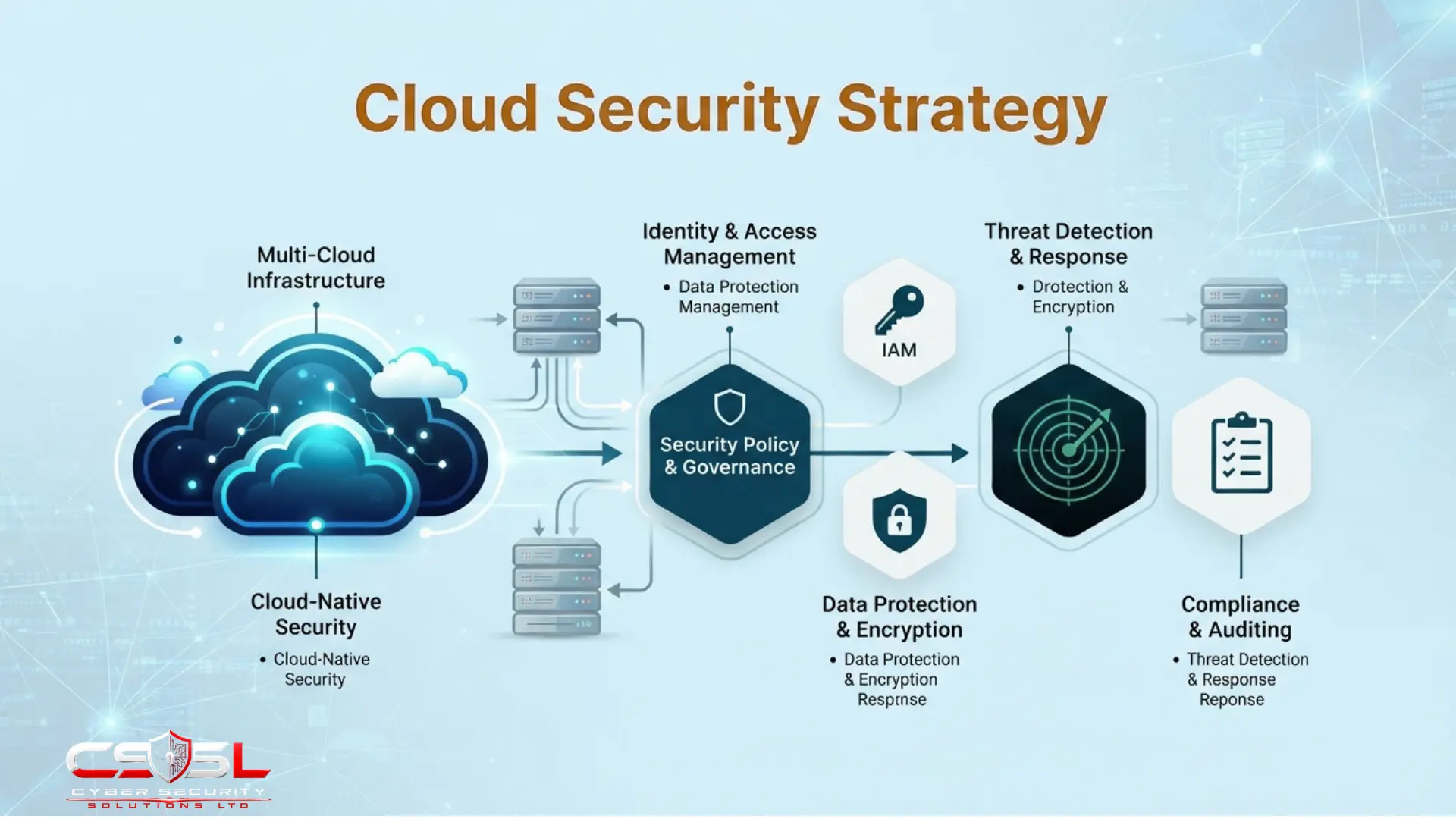
A cloud security strategy is the business-aligned planning process determining what an organization prioritizes, funds, and sequences to reduce cloud risk over time, covering governance, budget, and roadmap. This is distinct from cloud security architecture, the technical blueprint that strategy decisions ultimately produce and fund.
If you wrote a cloud security strategy document eighteen months ago and nobody has looked at it since, or your board asked for your cloud security roadmap and you have nothing beyond a list of tools you own, this guide gives you a genuinely usable process rather than generic planning advice.
What Is a Cloud Security Strategy, and How Is It Different from Architecture?
A cloud security strategy is the business-aligned decision-making process governing what an organization prioritizes, funds, sequences, and builds toward over time to reduce cloud risk, covering risk tolerance, resourcing, governance, and roadmap. If architecture is the blueprint, strategy is the business case, funding plan, and phased construction schedule behind actually building it.
Strategy needs dedicated treatment separate from architecture because architecture covers what tools, controls, and structures exist and how they work technically, while strategy covers how an organization actually decides which of those to prioritize, in what order, with what budget, and who is accountable. See Cloud Security Architecture: How to Design a Secure Cloud Environment for the technical blueprint this strategy process ultimately produces and funds.
Why Do Most Cloud Security Strategies Fail Before They Are Ever Implemented?
Most cloud security strategies fail through a small number of recurring, avoidable patterns: treating strategy as a static document written once and never revisited, building a security-only strategy disconnected from business objectives that competes for budget rather than enabling growth, having no named executive sponsor with authority to defend priorities, attempting every domain simultaneously with no sequencing, and building priorities on assumption rather than an honest current-state maturity baseline.
The static document failure pattern deserves recognition as the same recurring failure mode already visible elsewhere in an organization’s security tooling, not a separate, novel problem unique to strategy. This connection gives the diagnosis genuine explanatory power rather than treating strategic failure as an isolated phenomenon requiring its own unrelated explanation.
Consider the pattern already established at the tool level: IAM configuration treated as a one-time project accumulates excessive permissions over time because nobody revisits it after initial rollout. CSPM configuration treated as a one-time deployment misses drift because nobody rescans continuously. DLP policy treated as a set-and-forget exercise misses new data flows because nobody updates it as the environment changes. In every one of these cases, the underlying failure is identical: a point-in-time decision was treated as permanently valid in an environment that changes continuously.
Cloud security strategy fails through the exact same mechanism, simply at a higher altitude. A strategy document produced through a genuinely thoughtful planning exercise, with real executive input and careful domain prioritization, is not wrong at the moment it is written. It becomes wrong progressively, as the threat landscape shifts, as business priorities change, as the organization’s actual cloud footprint grows in ways the original document never anticipated, exactly the way a carefully designed IAM structure becomes progressively less accurate over time without ongoing verification. A strategy document filed away and revisited only when someone happens to remember it exists is not a governance failure unique to strategic planning; it is the identical failure pattern that produces permission sprawl, configuration drift, and unreviewed DLP gaps, simply operating on organizational priorities rather than technical settings. Recognizing this connection is what makes the fix obvious: strategy needs the same ongoing, scheduled review cadence that CSPM and CIEM apply to technical configuration, not a one-time planning exercise treated as permanently complete.
How Do You Align Cloud Security Strategy with Business Objectives?
A strategy framed around enabling faster, more confident cloud adoption receives fundamentally different organizational reception than one framed purely as risk avoidance. Translate business priorities into security priorities concretely: a business strategy to enter a regulated market directly elevates specific compliance-related priorities, while an aggressive cloud migration plan directly elevates migration-specific security priorities.
Speak the language of business risk rather than purely technical risk when presenting to non-technical stakeholders, using financial justification and cost-avoidance framing rather than technical severity scores alone. Strategy decides what to prioritize and why; the detailed financial calculation and presentation method belongs to a separate, dedicated business case exercise.
What Is Cloud Security Governance, and Who Should Actually Own Strategic Decisions?
In this context, governance means the broader organizational decision-making structure, executive sponsorship, steering committee, decision rights, and escalation, that governs all strategic cloud security choices, not just the provider-and-customer responsibility line. A governance structure typically includes an executive sponsor, increasingly a CISO or equivalent, a steering group bringing together security, cloud engineering, compliance, and relevant business units, clear decision rights over budget approval and risk acceptance, and a defined escalation path for when strategic priorities conflict with operational urgency.
This use of the word governance deserves explicit disambiguation from a narrower use of the identical term elsewhere in cloud security discussion, since using one word for two genuinely different scopes creates real confusion for readers who encounter both. Elsewhere, governance describes the specific, technical exercise of mapping the shared responsibility boundary onto named internal owners for specific controls: who owns encryption configuration, who owns access review, who owns incident response for a given service. That is a genuinely valuable and necessary exercise, but it operates at the level of individual technical controls.
Governance in this strategic context is broader and sits above that technical mapping entirely. It answers a different question: who decides which domains get budget this year, who has authority to accept residual risk on behalf of the organization, and who is accountable when strategic priorities conflict with an urgent operational request that would derail the roadmap. An organization can have excellent technical-control governance, every setting mapped to a named owner, while having no strategic governance at all, no one with actual authority to defend the roadmap when a competing budget request arrives with more immediate business pressure behind it. Weak strategic governance erodes even a well-designed strategy piecemeal over time as competing priorities and budget constraints chip away at it without anyone holding clear authority to defend it.
RACI-style clarity, explicitly documenting who is Responsible, Accountable, Consulted, and Informed for major strategic decisions, tool selection, budget allocation, risk acceptance, is the practical governance tool that prevents the exact ambiguity that leads directly to unowned responsibilities at the technical level, applied instead to the strategic decisions that determine which technical work happens at all. See Cloud Security Shared Responsibility Model for the narrower, technical-control mapping this section deliberately distinguishes from.
How Do You Use the Cloud Security Domains to Sequence Your Strategy?
The seven cloud security domains, identity and access management, infrastructure security, data security, application security, threat detection and incident response, compliance and governance, and posture management, provide a practical sequencing tool rather than merely a descriptive list. Score each domain against your organization’s specific risk exposure and current maturity, then sequence investment starting with domains combining high risk and low maturity. Identity and data consistently deserve first-priority sequencing regardless of organization type, since these are the elements that never fully transfer to the cloud provider under any service model.
Treating these seven domains as a literal, scorable sequencing exercise, rather than a list to address in some unspecified order, is what genuinely separates methodological rigour from generic planning advice. Most competitor content stops at naming the domains and offering the vague instruction to prioritize based on risk, without ever showing readers how to actually convert that instruction into a specific, defensible sequence.
The practical exercise works like this: for each of the seven domains, assign a risk score reflecting how significant that domain’s specific threat exposure is for your organization, drawing on a structured risk assessment rather than intuition. Then assign a maturity score reflecting your current state in that domain, using the five-stage framework covered next. Plot these two scores against each other for all seven domains. The domains landing in the high-risk, low-maturity quadrant are your genuine starting priorities, not because they are the most discussed domains in industry media, but because they represent the combination of significant exposure and current weakness that most directly reduces overall organizational risk when addressed first. A domain with high risk but already strong maturity needs maintenance, not urgent new investment. A domain with low risk and low maturity can reasonably wait. Only the intersection of high risk and low maturity genuinely demands immediate sequencing priority.
This scoring exercise also directly explains why attempting every domain simultaneously virtually guarantees the failure pattern named earlier: seven domains addressed with equally divided attention and budget means no domain receives the concentrated investment needed to move meaningfully from one maturity stage to the next, producing broad, shallow progress everywhere rather than genuine improvement anywhere that a security team, board, or client can actually point to as evidence the strategy is working.
How Do You Assess Your Current Cloud Security Maturity?
| Stage | Characteristics | Typical Tooling State | Next Priority |
| Initial/Ad Hoc | No formal controls, reactive | Minimal or absent | Establish baseline visibility |
| Developing | Tools deployed, inconsistently applied | Manual, sporadic | Consistent tool coverage |
| Defined | Documented policy, consistent tooling | Consistent across most domains | Automation and metrics |
| Managed | Metrics-driven, largely automated | Automated with review cadence | Continuous refinement |
| Optimizing | Continuous improvement, proactive | Fully automated, proactive | Maintain and evolve |
An honest maturity baseline is a prerequisite for realistic strategy, not an optional nice-to-have, since without it priorities rest on assumption rather than evidence.
The specific evidence source for this maturity assessment deserves explicit correction from the default most competitor guidance recommends, since the standard approach carries a predictable and significant accuracy problem. Most maturity assessment guidance defaults to a workshop-style self-assessment, gathering stakeholders in a room and asking them to rate their own domain’s maturity on a defined scale. This method is vulnerable to a specific, well-documented bias: the people closest to a domain are frequently the least objective judges of its actual maturity, since they have every incentive, conscious or not, to describe their own area of responsibility favourably.
Organizations already running CSPM, DSPM, and CIEM tooling have a far more objective evidence source sitting unused for this exact purpose. CSPM findings show precisely how many configuration violations currently exist against a recognized benchmark, providing hard, current evidence of actual infrastructure security maturity rather than a self-reported estimate. DSPM findings reveal exactly how much sensitive data sits undiscovered or unclassified, a direct, measurable indicator of data security maturity that no self-assessment survey could produce with the same accuracy. CIEM findings show the actual volume of excessive and shadow permissions across the environment, providing objective evidence of identity and access maturity independent of anyone’s self-reported confidence in their own access management practices.
Using this existing tool output as maturity evidence, rather than commissioning a separate workshop-based assessment exercise, produces a genuinely more rigorous and immediately actionable baseline. It also means the maturity assessment itself requires no additional tooling investment for organizations already running posture management tools, simply a deliberate exercise in reading existing findings through a maturity lens rather than only a tactical remediation lens. This general framework applies to any organization size, though very large enterprises face additional complexity applying it consistently across business units and regions.
How Do Compliance Obligations and Standards Shape Your Strategy Without Dictating It?
Compliance obligations and recognized standards function as strategic inputs shaping prioritization, not the subject of strategy itself. A healthcare organization’s compliance obligations directly elevate data security and access control priorities within the domain-sequencing exercise. A government contractor’s specific compliance obligations directly shape which cloud regions and services are even viable options.
Explaining precisely why compliance-driven prioritization is legitimate but insufficient alone matters because most competitor content implicitly treats compliance and genuine risk reduction as effectively synonymous, an assumption that can leave organizations confidently exposed in areas their compliance framework simply never addresses.
Meeting a specific framework’s minimum requirements demonstrates that an organization has satisfied a defined, external baseline, which is genuinely valuable and often commercially necessary. It does not necessarily mean the organization’s actual highest risk exposure has been addressed, because compliance frameworks are written to establish minimum acceptable standards across an entire regulated population, not to reflect any single organization’s specific threat profile. An organization can achieve full compliance with a relevant framework’s technical requirements while remaining significantly exposed in a specific area that framework does not weight heavily, or does not address at all, simply because the framework was never designed around that organization’s particular business model, data types, or attack surface.
The correct relationship is that compliance obligations should inform sequencing decisions, elevating certain domains where genuine legal and regulatory consequence exists, without ever fully replacing the independent, risk-based prioritization exercise covered above. An organization that sequences its entire cloud security strategy purely around compliance checklist completion, treating a passed audit as equivalent to genuine security maturity, has optimized for demonstrating a specific external standard rather than for reducing its own actual risk, and these two goals, while related, are not identical.
Build, Buy or Managed Service — How Do You Decide?
| Criteria | Build | Buy | Managed Service |
| In-house skill required | High, sustained | Moderate | Low |
| Control level | Highest | High | Moderate |
| Speed to capability | Slowest | Moderate | Fastest |
| Ongoing cost structure | Salary and retention | Licence plus ops | Recurring service fee |
| Best suited for | Central, strategic domains | Adequate in-house operation capacity | Limited internal capacity |
Build suits organizations with sufficient budget, sustained need, and the ability to attract and retain increasingly scarce, specialized cloud security talent. Buy suits organizations with adequate in-house capability to operate tooling but wanting to avoid building fully custom capability from scratch. Managed service suits organizations lacking the in-house capacity to properly configure, monitor, and act on posture management findings, since a tool deployed without genuine remediation capacity produces alerts without producing risk reduction.
This decision should be made domain by domain rather than as one blanket organizational choice, and most competitor content presents it as a single decision applying uniformly to the entire security function, missing that different domains within the same organization frequently warrant genuinely different approaches based on domain-specific maturity, in-house skill availability, and strategic importance.
Consider a realistic scenario: an organization might reasonably build strong in-house capability for identity and access management specifically, since IAM design decisions are so central to everything else the organization does that maintaining deep internal expertise there justifies the investment, while simultaneously choosing a managed service for its broader cloud security posture management function, since the organization lacks the specialist, scarce cloud security talent needed to properly configure, tune, and act on CSPM findings continuously. Both decisions are entirely rational for the same organization at the same time, reflecting genuinely different maturity and resourcing realities across those two specific domains, not an inconsistent or poorly thought-through overall strategy.
Applying a single blanket decision across all seven domains ignores the reality that domains differ enormously in how much they benefit from deep internal ownership versus how effectively they can be delegated to a specialist external provider. The (ISC)² Cybersecurity Workforce Study consistently documents the scarcity of specialized cloud security talent, a scarcity that affects some domains far more acutely than others. Making this decision domain by domain, informed by the same maturity and risk scoring exercise already applied to sequencing, produces a more realistic and sustainable resourcing strategy than any single organization-wide commitment.
How Do You Build a Realistic Cloud Security Roadmap and Budget?
Address the highest-risk, lowest-maturity domains first per the sequencing exercise, balanced against early quick wins that build organizational momentum and protect continued executive sponsorship. Compare proposed investment against cost-of-incident logic rather than requesting budget based on vendor-recommended spending benchmarks alone.
A multi-year roadmap, reviewed at least annually, serves better than a single-year plan, since cloud security maturity genuinely takes years to build across all seven domains, and a realistic multi-year view sets appropriate executive expectations rather than implying complete coverage is achievable in one budget cycle. Build review checkpoints tied directly to the governance structure established earlier, so the roadmap adjusts as maturity, risk, and business priorities evolve rather than remaining fixed once approved.
How Do You Build a Cloud Security Strategy Step by Step?
Step 1: Establish governance structure and executive sponsorship before any technical prioritization work begins.
Step 2: Conduct an honest current-state maturity assessment across all seven domains, using CSPM, DSPM, and CIEM findings as evidence rather than assumption.
Step 3: Conduct or commission a structured risk assessment to identify and prioritize genuine risk exposure.
Step 4: Map business objectives and compliance obligations as additional prioritization inputs alongside risk assessment.
Step 5: Sequence domain investment starting with the intersection of highest risk and lowest current maturity.
Step 6: Make build, buy, or managed-service decisions domain by domain based on internal capability and resourcing realities.
Step 7: Build a phased, multi-year roadmap balancing highest-priority work against early quick wins.
Step 8: Establish a regular review cadence, tied to your governance structure, to reassess and adjust as the environment and business evolve.
Cyber Security Solutions Ltd provides expert facilitation for building or refining a cloud security strategy, including maturity assessment and domain sequencing, for organizations wanting outside expertise to drive this process rather than building it entirely in-house.
Conclusion
A cloud security strategy that actually works treats domains as a scorable sequencing exercise rather than a checklist, grounds maturity assessment in objective tool evidence rather than self-reported optimism, and builds governance with real authority to defend priorities against competing demands. Visit cybersecuritysolutionsltd.com for expert help building or facilitating your cloud security strategy, including maturity assessment and domain sequencing.
FAQs
A cloud security strategy is the business-aligned planning process determining what an organization prioritizes, funds, and sequences to reduce cloud risk over time. It covers governance, budget, and roadmap, distinct from architecture, which is the technical blueprint strategy decisions ultimately produce and fund.
Architecture is the technical blueprint, the specific tools, controls, and structures an organization builds. Strategy is the business case, funding plan, and phased schedule determining which parts of that blueprint get built, in what order, with what budget, and who is accountable for the decisions.
Strategies fail through recurring patterns: treating strategy as a static document never revisited, building a security-only plan disconnected from business goals, having no named executive sponsor, attempting every domain simultaneously with no sequencing, and building priorities on assumption rather than an honest maturity baseline.
Strategic governance is the organizational decision-making structure, executive sponsorship, steering committees, and decision rights governing all strategic choices. Shared responsibility mapping is the narrower, technical exercise of assigning ownership for specific controls. Both matter, but they operate at genuinely different levels.
Use a five-stage framework from Initial/Ad Hoc through Optimizing, and ground the assessment in objective evidence rather than self-reported workshop scoring. Existing CSPM, DSPM, and CIEM findings provide hard evidence of actual configuration, data exposure, and permission state far more reliable than subjective self-assessment.
Decide domain by domain rather than as one blanket choice. Build suits domains needing deep, sustained internal expertise. Buy suits organizations with adequate operational capacity. Managed service suits domains where internal capacity cannot properly configure, monitor, and act on findings continuously.