What Is Data Theft? How It Happens and How to Prevent It
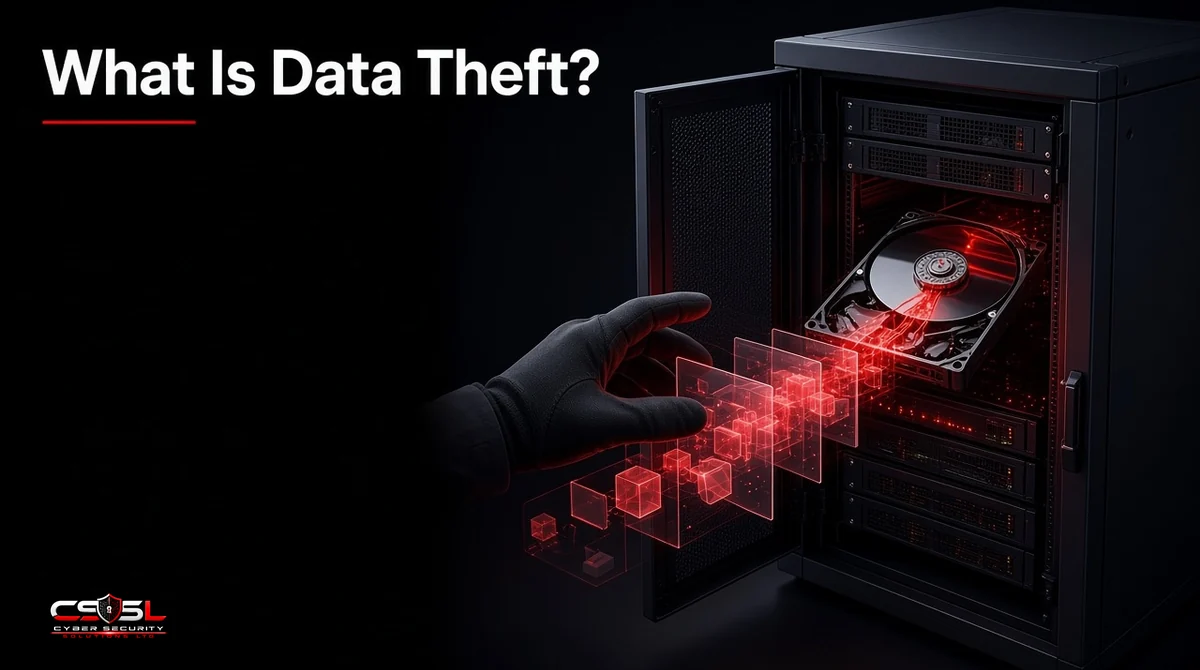
Data theft is the unauthorized copying, transfer or retrieval of sensitive information, such as customer records, passwords, financial details or trade secrets, from a person or organization. It happens through phishing, malware, stolen credentials, misconfigured cloud storage, lost devices and insiders who misuse their access. Unlike a lost laptop, the attacker usually wants the data to sell, exploit or hold for ransom.
The original data often stays in place, which is why data theft can go unnoticed for months. Nothing looks missing; a copy has simply left.
What Types of Data Do Criminals Steal?
- Personal data: names, addresses, dates of birth, national insurance or Social Security numbers
- Credentials: usernames, passwords and session tokens that open further systems
- Financial data: card numbers, bank details and payroll records
- Health records: valuable because they are hard to change and rich in detail
- Intellectual property: designs, source code, pricing and customer lists
- Business communications: email archives used for fraud or extortion
How Data Theft Happens
Most incidents start with one of a handful of routes.
- Phishing: staff are tricked into giving up passwords or opening malware
- Stolen or reused passwords: attackers log in rather than break in
- Malware and ransomware: many ransomware groups now copy data before encrypting it, then threaten to publish it
- Cloud misconfiguration: storage left open to the internet
- Unpatched systems: known flaws in internet-facing software
- Insiders: employees or contractors taking data when they leave or for profit
- Lost or stolen devices: unencrypted laptops, phones and USB drives
- Third parties: suppliers with access to your systems or data
The Four Stages of a Data Theft Attack
Understanding the stages shows where you can interrupt an attack.
- Identify: the attacker finds where valuable data lives, often by browsing shared drives and databases after gaining access.
- Prepare: they gather it into one place and often compress or encrypt it to avoid detection.
- Transfer: they move it out, using cloud storage services, email, encrypted web traffic or removable media. This step is called exfiltration.
- Cover tracks: they delete logs or use legitimate tools so the activity blends in.
Picture an illustrative 80-person engineering consultancy. An attacker phishes a project manager’s password and, because there is no MFA, logs in to the firm’s cloud file share. Over two weekends they search for client drawings and contracts, zip them into a few large archives and upload them to a personal cloud storage account. No files disappear, so nobody notices until a client calls about a ransom email. The firm had logging switched on but no one reviewing it.
Use this decision rule when deciding where to invest first: if you can only add one control, put it at the transfer stage for your most valuable data, by alerting on large downloads, uploads to personal cloud services and unusual archive creation. Most attackers can reach data more easily than they can move it out unnoticed, so the exit is often your best chance to stop them.
Insider Data Theft: A Special Case
Insiders are harder to spot because they already have legitimate access. The highest-risk moment is usually when someone is leaving, especially to a competitor. Common patterns include forwarding files to a personal email address, syncing a work folder to a personal cloud account, printing large volumes or copying data to USB drives in the final weeks of employment.
Controls should be fair and transparent. Tell staff in policy that activity is monitored, limit bulk export rights to roles that need them, and block or alert on personal cloud uploads and removable media for sensitive data. When someone resigns, review their recent access with HR and remove accounts on their last day, not weeks later. Contracts and confidentiality clauses give you legal options if data is taken, but only if you can show what happened, so keep audit logs long enough to cover a typical notice period.
Consequences of Data Theft for Businesses
Stolen data creates costs long after the incident: investigation and recovery, notifying affected people, regulatory penalties, legal claims, lost customers and, for intellectual property, lost competitive advantage. Extortion adds pressure, because criminals threaten to publish data unless paid, and paying does not guarantee deletion.
Regulators also look at whether you took reasonable steps beforehand. Under UK GDPR, the ICO can consider the security measures in place when deciding on enforcement, so documented controls and staff training matter as much after an incident as before it.
How to Prevent Data Theft: 10 Steps
- Know where sensitive data lives: keep an inventory and classify it.
- Turn on MFA everywhere, starting with email, remote access and admin accounts.
- Apply least privilege: people should reach only the data their role needs.
- Encrypt devices and sensitive data at rest and in transit.
- Patch internet-facing systems quickly.
- Check cloud storage settings for public access.
- Use data loss prevention (DLP) rules for email, cloud and endpoints.
- Monitor for exfiltration signs: large downloads, unusual uploads, new forwarding rules.
- Remove access promptly when staff and contractors leave.
- Train staff to spot phishing and report it fast.
Signs Your Data Has Been Stolen
- Unusual sign-ins or downloads in audit logs
- Large outbound transfers, especially at night or weekends
- Customers reporting targeted phishing that uses real details
- Your data or credentials appearing on leak sites or in breach alerts
- An extortion email
What to Do After Data Theft
Act quickly and in order.
- Contain: reset compromised accounts, revoke sessions and block the exfiltration route.
- Preserve evidence: keep logs and do not wipe affected systems until they are investigated.
- Assess what was taken and whose data it was.
- Report and notify. In the UK, UK GDPR requires reporting a personal data breach to the ICO within 72 hours of becoming aware of it when it poses a risk to people’s rights, and informing affected individuals when the risk is high. Report crime to Report Fraud. In the US, state breach notification laws set duties to notify affected residents, and sector rules such as HIPAA add their own; incidents can be reported to the FBI’s IC3 and CISA.
- Support affected people with clear guidance, such as changing passwords and watching for fraud.
- Fix the root cause and review what would have caught it sooner.
FAQs
A data breach is any incident where data is exposed, lost or accessed without permission. Data theft is a breach in which someone deliberately takes the data.
Yes. In the UK it can fall under the Computer Misuse Act 1990 and the Data Protection Act 2018. In the US, the Computer Fraud and Abuse Act and state laws apply.
Yes. Insiders, including departing staff and contractors, are a common source.
They use normal-looking routes such as cloud storage, encrypted web traffic and email, often in small amounts or out of hours.
It makes stolen data unreadable if keys are protected, but not if the attacker steals it through a logged-in account that can decrypt it.
Yes. Small firms hold customer and payment data and often have fewer controls, which makes them attractive targets.
Reducing Your Data Theft Risk
Data theft is easiest to stop when you know where your sensitive data is and watch the routes it can leave by. If you want help finding those gaps, Cyber Security Solutions Ltd offers a free, no-obligation assessment through our contact page.