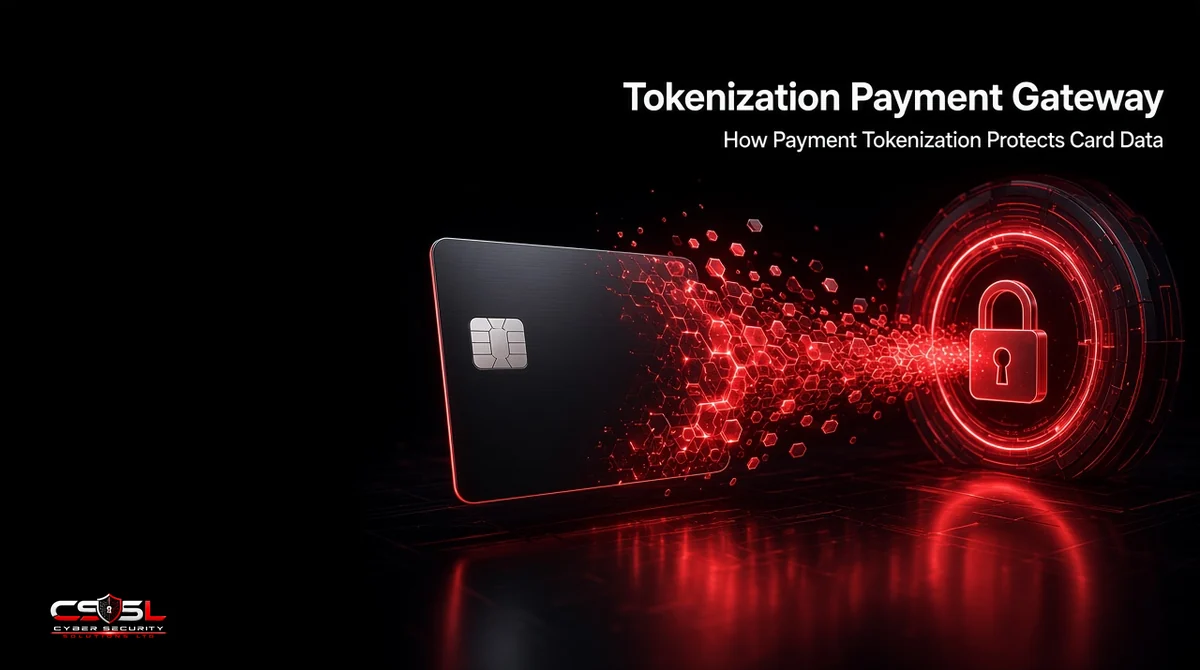
Tokenization Payment Gateway: How Payment Tokenization Protects Card Data
Think of a coat check. You hand over your coat and get a numbered ticket that is worthless to anyone else. A tokenization payment gateway works the same way: it keeps the real card number in a secure vault and gives your business a random token, so a stolen database holds tickets, not cards.
What Is Tokenization?
Tokenization replaces sensitive data, such as a credit card number, with a random substitute value called a token that has no meaning or value if stolen. The real data is stored securely by a tokenization service, and only that service can swap the token back for the original.
What Is Data Tokenization in Cyber Security?
In cyber security, data tokenization is a data protection method used for card numbers, Social Security numbers, National Insurance numbers, bank details and health identifiers. Applications work with tokens, while the sensitive values sit in one tightly controlled place.
What Is a Token?
A token is a stand-in value, often the same length and format as the original so existing systems accept it. A card token might keep the last four digits for receipts while the rest is random. Unlike encrypted data, a token is not mathematically derived from the original, so it cannot be “cracked” back.
How a Tokenization Payment Gateway Works
Step by Step: From Card Entry to Token
- The customer enters card details on a payment form hosted or scripted by the gateway.
- The card data goes straight to the gateway, bypassing the merchant’s servers.
- The gateway stores the card number in its secure vault and creates a token.
- The merchant receives and stores only the token.
- For a charge, the merchant sends the token to the gateway, which looks up the real card and processes the payment with the card network.
The Token Vault and Detokenization
The vault is a heavily protected database that maps tokens to real card numbers. Detokenization, swapping a token back, happens only inside the provider’s environment and only for authorized requests, such as sending a payment for authorization.
Example: Recurring Billing
A subscription business charges customers monthly. Instead of storing card numbers, it stores gateway tokens. Each month it sends the token and amount to the gateway. If its customer database is breached, the attacker gets tokens that cannot be used outside that merchant’s gateway account.
Types of Payment Tokens
Gateway Tokens vs Network Tokens
Gateway (or PCI) tokens are issued by a payment gateway or processor and usually work only with that provider. Network tokens are issued by card networks such as Visa and Mastercard under the EMVCo Payment Tokenisation Specification. They can be updated automatically when a card is reissued, and the networks promote them as improving approval rates and reducing fraud.
Device Tokens (Apple Pay and Google Pay)
Mobile wallets store a device-specific token rather than the card number. Each payment adds a one-time cryptogram, so a captured token is useless on another device or for another transaction.
Single-Use vs Multi-Use Tokens
Single-use tokens represent one transaction. Multi-use tokens represent a stored card for repeat purchases or subscriptions.
Tokenization vs Encryption vs Data Masking
| Tokenization | Encryption | Data masking | |
|---|---|---|---|
| How it works | Swaps data for a random token, original stored in a vault | Scrambles data with an algorithm and key | Hides part or all of the data for display or testing |
| Reversible? | Only through the tokenization service | Yes, with the key | Usually not (static masking) |
| If stolen | Tokens alone are useless | Safe only while keys stay secret | Masked values reveal little |
| Typical use | Stored card numbers, IDs | Data at rest and in transit | Test data, screens, receipts |
| Effect on PCI scope | Can remove systems from scope | Systems holding keys stay in scope | Limited on its own |
Most businesses use all three: encryption for data at rest and in transit, tokenization for stored payment data, and masking for display and testing.
Vaulted vs Vaultless Tokenization
Vaulted tokenization stores the mapping between tokens and real values in a database. It is simple to understand but the vault must be scaled and protected. Vaultless tokenization generates tokens using cryptographic methods, so there is no lookup database, which can improve performance. Both are offered by established providers; the security of either depends on protecting keys and access.
Tokenization and PCI DSS Scope Reduction
PCI DSS applies to every system that stores, processes or transmits cardholder data, and to systems connected to them. Tokenization’s biggest practical value is shrinking that scope. The PCI Security Standards Council’s tokenization guidelines explain that systems holding only tokens, with no ability to detokenize, may be removed from PCI DSS scope, provided the tokenization system itself is properly secured and segmented.
In practice:
- Use a gateway-hosted payment page or field so card data never touches your servers
- Store only tokens in your applications, databases, logs and backups
- Remove old stored card numbers after migrating to tokens
- Confirm with your acquirer or Qualified Security Assessor which self-assessment questionnaire applies
- Keep your payment pages secure: PCI DSS v4.0 added requirements, mandatory since March 31, 2025, to manage and monitor scripts on payment pages
Tokenization reduces scope but does not remove PCI DSS obligations entirely.
Tokenization Data Security Benefits
- Less damage from a breach: stolen tokens cannot be used elsewhere
- Reduced PCI DSS scope: fewer systems to secure and assess
- Smoother card updates: network tokens can update when cards are reissued
- Safer analytics and testing: teams can work with tokens instead of real data
Data Tokenization Examples Beyond Payments
Healthcare organizations tokenize patient identifiers so analytics teams can link records without seeing names. HR and payroll systems tokenize Social Security or National Insurance numbers. Retailers tokenize customer emails and phone numbers in marketing databases, keeping real values in a restricted system.
Tokenization and Compliance in the US and UK
US: PCI DSS v4.0, CCPA/CPRA, HIPAA and GLBA
PCI DSS v4.0.1 is the current version of the card data standard. Tokenization supports HIPAA, GLBA and California privacy requirements to protect sensitive data with reasonable safeguards, though tokenized data that can be re-identified may still count as protected.
UK: PCI DSS, UK GDPR Pseudonymization and FCA Rules
PCI DSS applies to UK merchants in the same way. Under UK GDPR, tokenized personal data is usually pseudonymized, not anonymized, so it is still personal data, but the ICO recognizes pseudonymization as a security measure that reduces risk. Payment firms regulated by the FCA must also meet its operational resilience and security expectations.
Limitations and Risks of Tokenization
- The token vault or tokenization service becomes a high-value target
- Gateway tokens can create lock-in, making a switch of provider harder
- Card data captured before tokenization, such as by malicious scripts on a checkout page, is not protected
- Tokenization does not replace encryption, access controls or monitoring
How to Choose a Tokenization Provider
Check that the provider is PCI DSS validated as a service provider, supports network tokens, offers hosted payment fields, allows token migration if you switch providers, and provides clear documentation of your remaining PCI responsibilities.
Is Your Tokenization Payment Gateway Doing Its Job?
A tokenization payment gateway only reduces risk if real card numbers truly never reach your systems. Here is the challenge: search your databases, logs and backups for full card numbers this week. If you find any, your scope is bigger than you think. Cyber Security Solutions Ltd can help you check your card data footprint through our contact page.
FAQs
No. PCI DSS does not require tokenization. It requires you to protect stored cardholder data, for example with strong encryption, truncation or tokenization. Many merchants choose tokenization because it removes stored card numbers from their systems, which can shrink PCI DSS scope and simplify their self-assessment questionnaire.
Not by the merchant or an attacker holding only the token. Tokens are random values, not encrypted versions of the card number, so there is no key to crack. Only the tokenization provider can detokenize, inside its secured environment, and only for authorized requests such as processing a payment.
It depends on the token type. Network tokens issued through Visa or Mastercard can be updated automatically when the bank reissues a card, so the token keeps working. Gateway tokens may need the gateway's card updater service, or the customer may need to enter new card details.
For stored payment data, tokenization often reduces more risk because stolen tokens are useless and systems holding them may fall out of PCI scope. Encryption remains essential for data in transit and at rest, but encrypted data can be exposed if keys are stolen. Most organizations use both together.
Yes. Apple Pay and Google Pay are built on tokenization. They store a device-specific token instead of the real card number, and each payment includes a one-time cryptogram. Merchants never receive the actual card number, which reduces their exposure and helps protect customers if a device is lost.
Not on its own. Tokenization protects card data after the gateway receives it. If attackers inject malicious scripts into your checkout page, they can capture card numbers as customers type them. Using gateway-hosted payment fields and monitoring payment page scripts, as PCI DSS v4.0 requires, closes much of that gap.