Cyber Security Governance: How to Build a Framework That Lasts

Cyber security governance is the structure of accountability, policy, and oversight guiding an organization’s security decisions. GRC, Governance, Risk, and Compliance, describes the three interconnected disciplines that make governance actually function: setting direction, understanding exposure, and verifying adherence to requirements.
If you’re confused by the GRC acronym and skeptical whether your organization’s governance is genuinely working, not just documented, this breaks it down honestly.
What Is Cyber Security Governance, and What Does GRC Mean?
Cyber security governance is the structure of accountability, policy, and oversight that guides how an organization actually makes security decisions, who’s responsible, how priorities get set, how progress gets measured. It’s the framework everything else operates within.
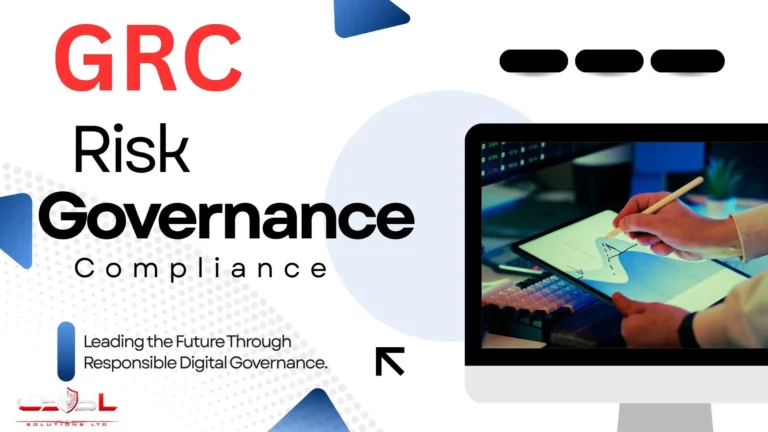
GRC stands for Governance, Risk, and Compliance, three interconnected disciplines that together make governance genuinely functional. Governance sets direction and accountability. Risk understands what could go wrong. Compliance verifies specific requirements are actually met. None of the three works particularly well in isolation from the other two.
Governance, Risk, Compliance: Three Questions, Working as One System
Each pillar of GRC answers a genuinely distinct question. Governance asks who’s accountable and what strategic direction guides security decisions. Risk asks what could go wrong across the organization, and how severely. Compliance asks whether specific, defined requirements, regulatory or contractual, are actually being met.
Treated as separate, disconnected functions, these three produce exactly the fragmented outcome many organizations currently experience: risk teams that don’t see compliance gaps, compliance teams that don’t understand actual threat context, and boards receiving quarterly reports that never quite connect the three pictures into one coherent view. Treated as one integrated system, each pillar informs the other two continuously, risk findings shaping compliance priorities, compliance gaps feeding directly into risk assessment, governance decisions grounded in both.
The Current Numbers: Why 42% of GRC Systems “Need Improvement”
Here’s a precisely verified, genuinely sobering statistic worth understanding directly. McKinsey’s 2025 Global GRC Benchmarking Survey, drawing on nearly 200 corporate leaders, found 42% of respondents say their organization’s IT and GRC systems “need improvement,” with a further 15% describing them as absent or lagging entirely.
GRC Maturity by the Numbers (McKinsey 2025)
| Metric | Figure |
| Organizations saying GRC systems “need improvement” | 42% |
| Organizations describing GRC systems as absent or lagging | 15% |
| Average risk maturity score | 2.6 out of 4.0 |
| Average compliance maturity score | 2.9 out of 4.0 |
Here’s why this matters beyond a discouraging headline figure. This isn’t a lack of frameworks; organizations have invested in GRC tooling and structure for years. It’s genuine, widespread implementation failure, using available capability only partially, or running governance, risk, and compliance as disconnected departments that don’t share information effectively. A business with a documented risk register, a compliance checklist, and a governance policy on paper can still score poorly here if none of the three genuinely talk to each other in practice.
The Regulations Driving This Right Now
Here’s the current regulatory pattern worth naming directly, rather than listing regulation names without connecting them. GDPR, PCI DSS 4.0, NIS2, DORA, and the EU AI Act are each independently converging on the same underlying requirement, arriving from genuinely different sectors and jurisdictions.
That requirement is continuous, evidenced governance, not periodic, documented compliance sitting in a folder reviewed once a year. GDPR’s own accountability principle already demanded demonstrable governance. PCI DSS 4.0 elevated previously optional controls to mandatory baselines. NIS2 and DORA extend binding cybersecurity governance obligations to a broader range of sectors than ever covered before. The EU AI Act adds governance requirements specifically around AI system risk. Each regulation arrived from a different direction, financial services, critical infrastructure, payment processing, artificial intelligence, yet all are independently landing on the identical conclusion: governance has to be genuinely evidenced, not merely claimed.
From Periodic Snapshots to a Living Posture — the Same Shift You’ve Seen Everywhere Else
Continuous control monitoring replaces the once-a-year audit snapshot with ongoing, automated evidence that controls are genuinely operating throughout the entire review period, not just present on the specific day an auditor happened to check.
This is precisely the same shift already reshaping vulnerability management, moving from periodic scanning toward continuous exposure management, and security posture assessment, moving from static reports toward live dashboards. Governance is simply the latest domain experiencing this identical transition. Organizations using AI-driven continuous compliance monitoring reportedly detect policy violations considerably faster and reduce audit preparation time substantially compared to organizations still relying purely on periodic, manual review cycles.
What Does This Look Like in Practice? A Real UK Governance Role, Examined
Here’s a genuinely concrete, current example worth walking through rather than leaving governance abstract. The NHS’s Data Security and Protection Toolkit, DSPT, an annual self-assessment required of any organization accessing NHS patient data or systems, has undergone exactly this transition in real time.
For organizations in scope, the DSPT changed to align fully with NCSC’s own Cyber Assessment Framework, moving deliberately away from checklist-style pass/fail assessment against fixed security standards, toward outcome-based, evidence-driven assurance instead. Under the new CAF-aligned approach, organizations use professional judgment to demonstrate they’re genuinely achieving key security and information governance outcomes, rather than simply confirming a fixed list of controls exists on paper.
Here’s the part worth understanding concretely. Organizations in scope must now undergo independent assessment, conducted by qualified assessors experienced specifically in CAF evaluation, with a mandatory deadline of June 30, 2026. This isn’t a self-graded exercise anymore; it requires external, evidence-based validation that governance outcomes are genuinely being achieved, not merely documented. That’s exactly the shift this entire discussion has been describing in the abstract, playing out as a real, binding requirement for a specific, defined population of UK health and care organizations right now. If your own organization has treated governance as a document sitting in a shared drive, updated once a year before an audit, the DSPT’s own transition shows precisely where broader regulatory expectation is heading: toward genuine, continuously demonstrable evidence, not periodic paperwork.
Bringing It Together: How Every Framework You’ve Already Covered Fits into One GRC Picture
Here’s a genuinely useful synthesis worth landing on directly. NIST CSF 2.0’s Govern function, ISO 27001’s broader management system, and NCSC’s CAF each approach governance from a different angle and different regulatory context, but all map cleanly onto the same underlying GRC structure.
Mapping Frameworks onto GRC
| Framework | Maps Onto |
| NIST CSF 2.0 Govern function | Governance: named accountability, risk strategy, policy |
| ISO 27001 management system | Governance and compliance combined, formally certifiable |
| NCSC CAF / CAF-aligned DSPT | Compliance: outcome-based, evidence-driven assurance |
| Ongoing risk register and assessment | Risk: exposure understanding feeding governance decisions |
None of these are competing, unrelated frameworks fighting for the same budget line. Each addresses one piece of the same underlying GRC structure, named accountability, ongoing risk evaluation, and evidenced compliance, from a slightly different regulatory or organizational starting point. Cyber Security Solutions Ltd frequently helps organizations map their own existing framework investments, whatever combination they’ve already built, onto this one coherent GRC picture, rather than managing governance, risk, and compliance as three genuinely separate, disconnected projects competing for the same limited attention.
A Realistic Starting Point If You’re Building Your Very First GRC Function
Name one accountable governance owner first, before building anything else. A GRC function with no clear, single point of accountability tends to fragment exactly the way McKinsey’s own research found so many organizations already have.
Map which specific regulations genuinely apply to your business, rather than attempting to address every named regulation generically. A retailer handling payment cards faces a genuinely different regulatory picture than a financial services firm subject to DORA.
Build a simple, honest risk register as your starting point for the risk pillar, rather than attempting comprehensive, enterprise-scale risk modeling immediately.
Choose one organizing framework, NIST CSF 2.0 being a reasonable, well-supported default, rather than running governance, risk, and compliance as three separate, disconnected efforts each using its own incompatible structure and vocabulary.
Conclusion
Genuine governance isn’t a policy document sitting untouched between audits; it’s an accountable owner, honest risk understanding, and compliance you can actually evidence continuously, exactly the shift the NHS’s own DSPT is living through right now. Name your governance owner, map your real regulatory exposure, and pick one framework to organize around instead of three disconnected ones. If you want help building a GRC structure that actually holds together, Cyber Security Solutions Ltd can walk through it with you.
FAQs
GRC stands for Governance, Risk, and Compliance, three interconnected disciplines: governance sets accountability and direction, risk understands what could go wrong, and compliance verifies specific requirements are actually met, working together as one system.
Cyber security governance is the structure of accountability, policy, and oversight guiding an organization’s security decisions, defining who’s responsible, how priorities get set, and how progress gets measured across the entire organization.
Governance sets direction and accountability, risk assessment informs which threats and gaps genuinely matter, and compliance verifies specific requirements are met. Integrated together, each pillar informs the other two continuously rather than operating in isolation.
GDPR, PCI DSS 4.0, NIS2, DORA, and the EU AI Act are each independently converging on the same requirement: continuous, evidenced governance rather than periodic documentation, turning previously optional best practice into binding obligation.
Continuous compliance monitoring replaces the once-a-year audit snapshot with ongoing, automated evidence that controls are genuinely operating throughout the entire review period, rather than only proving compliance on the specific day an auditor checks.
Each addresses governance from a different angle, NIST CSF 2.0’s Govern function, ISO 27001’s management system, NCSC’s CAF-aligned DSPT, but all map onto the same underlying GRC structure of accountability, risk evaluation, and evidenced compliance.