What Are the Security Risks of Cloud Computing?
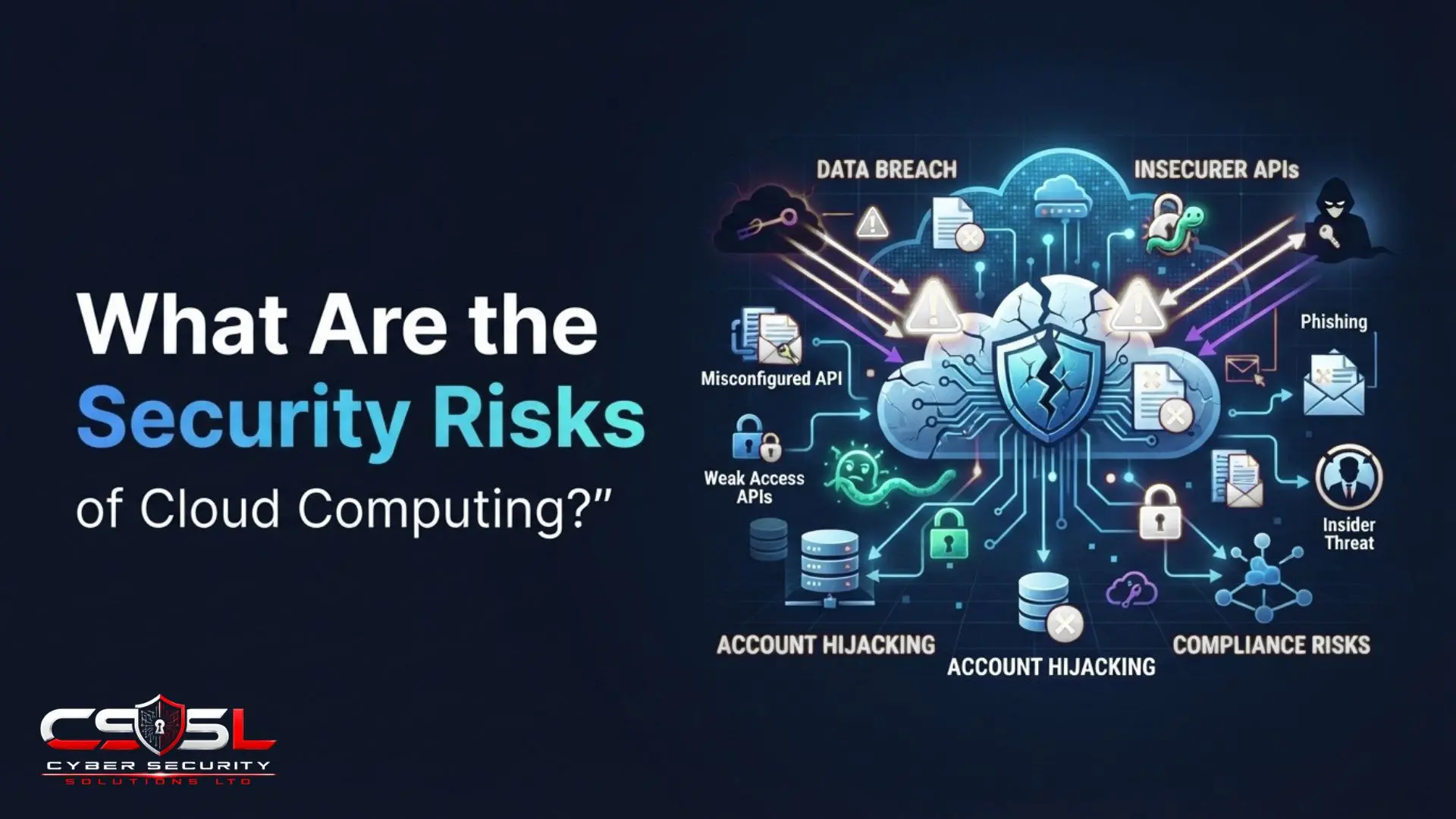
The main cloud computing security risks include misconfiguration exposing resources publicly, identity and credential attacks exploiting cloud’s anywhere-accessibility, insecure APIs, supply chain vulnerabilities through third-party integrations, and data exfiltration through legitimate cloud channels. Misconfiguration is consistently identified by CSA research as the leading cause of cloud breaches.
If you moved to the cloud and want to know specifically what you should be worried about, or your board wants a clear risk register for your cloud environment and you do not know where to start, this guide names and explains each risk with the specificity needed to act on it.
What Are the Main Security Risks of Cloud Computing?
Cloud computing introduces security risks that differ meaningfully from on-premise risks, not because cloud is inherently less secure, but because its accessibility, shared infrastructure, and configuration-heavy model create attack surfaces that did not exist in traditional IT.
The Cloud Security Alliance publishes its Top Threats to Cloud Computing research annually, based on industry practitioner input, providing a credible and current reference point for risk prioritisation. The MITRE ATT&CK Cloud Matrix provides a complementary taxonomy of specific attack techniques used against cloud environments in the wild.
Some cloud risks, such as misconfiguration, insecure APIs, and identity sprawl, are genuinely new in character. Others, such as malware and data theft, exist in on-premise environments but manifest differently and require different controls in cloud contexts. See Cloud Security Fundamentals: What Every Business Must Understand for the foundational framework these risks sit within.
What Is Misconfiguration and Why Is It the Leading Cloud Security Risk?
Cloud misconfiguration occurs when cloud resources, including storage buckets, databases, virtual machines, networking rules, and identity permissions, are set up with incorrect, insecure, or overly permissive settings that expose data or functionality to unauthorized parties.
Gartner has consistently projected that the vast majority of cloud security failures are attributable to customer misconfiguration rather than provider vulnerability. The cloud provider’s underlying infrastructure is generally well secured. Exposure occurs in the configuration layer the customer controls. Common examples include publicly accessible cloud storage buckets exposing sensitive files, database ports open to the internet, overly permissive IAM roles granting admin access to services needing only read access, and disabled logging removing visibility into what is happening across the environment.
Misconfiguration leads cloud risk not simply because people make mistakes, but because cloud’s specific architecture makes this class of error structurally more likely, more impactful, and harder to detect than any equivalent on-premise configuration error. In a traditional on-premise environment, a misconfigured server setting is limited in scope to that server, visible to the IT team who physically manages it, and typically caught during structured change management before causing any external exposure.
Cloud misconfiguration operates under completely different structural conditions. Cloud platforms expose hundreds of individual configuration parameters across dozens of services, and self-service provisioning means new resources are created at a pace and by a range of people, including developers, business operations teams, and IT generalists, that no structured review process can keep pace with. The blast radius of a single misconfiguration can be immediate and internet-scale: a storage bucket set to public access is visible to the entire internet simultaneously, not just the organization’s network.
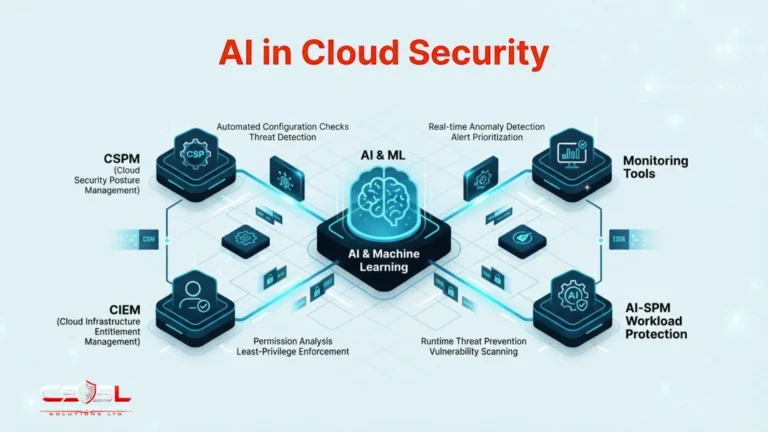
The detection gap compounds this further. Traditional software vulnerabilities are publicly disclosed in CVE databases when discovered, giving security teams advance warning and external signal. A misconfiguration is organization-specific, not tracked anywhere externally, and produces no automatic alert unless the organization actively monitors its own configuration state. An organization can have a publicly accessible Amazon S3 bucket containing customer data for months before discovery, not through its own monitoring but because an external security researcher finds it first. This is precisely why dedicated cloud security posture management tooling is the appropriate structural response. See What Is CSPM? Cloud Security Posture Management Explained for the technical solution.
What Are the Identity and Access Risks Unique to Cloud Environments?
Identity and access risks in cloud environments are structurally different because cloud services are accessible from anywhere using only valid credentials, removing the network perimeter that previously provided a secondary barrier.
Credential theft and account takeover represent the most direct access path to cloud-hosted data. Without multi-factor authentication, stolen or phished login details immediately grant attackers access without any network-level compromise. Excessive permissions and privilege creep accumulate over time as users change roles and access is provisioned without systematic review, increasing the damage any single compromised account can cause.
Service account and non-human identity risk is a frequently neglected attack surface. Cloud environments create large numbers of service accounts, API keys, and automated credentials connecting cloud services to each other. These are frequently over-privileged, infrequently rotated, and sometimes embedded in application code where discovery and rotation are significantly more complex than rotating a human password. Shadow IT and unmanaged identity emerge when employees create personal cloud accounts for work purposes, creating data and identity risks entirely outside the organization’s visibility.
Federated identity risk represents a category most cloud security content addresses inadequately, because it describes not a single compromised account but a structural multiplier that converts one credential compromise into simultaneous access across an entire cloud environment.
Single sign-on and identity federation are widely adopted because they simplify access management and enable consistent MFA enforcement. When an employee authenticates through a central identity provider like Microsoft Entra ID or Okta, that authentication applies across every connected cloud service. The identity provider itself becomes the single highest-value attack target in the entire environment. Compromise is not a single account compromise; it is simultaneous access to every cloud service the organization uses, including email, file storage, financial systems, and productivity platforms, all from one credential event.
Privileged access to the identity provider configuration, specifically the administrators who can modify authentication policies, add trusted services, or disable MFA requirements, represents an attack path of extraordinary impact that receives far less specific security attention than the individual application-level account security it governs.
What Cloud Security Vulnerabilities Do Attackers Actively Exploit?
Insecure APIs are the connective tissue of cloud environments. Insecure API design or configuration, including missing authentication, insufficient rate limiting, and excessive data exposure in API responses, gives attackers programmatic access to cloud functions and data that they actively probe for.
Publicly exposed cloud storage across Amazon S3, Azure Blob Storage, and Google Cloud Storage, set to public access through misconfiguration, has been the source of numerous documented large-scale data exposures, typically discovered by external security researchers rather than the affected organization. Unpatched vulnerabilities in customer-managed components on IaaS virtual machines, operating systems, middleware, and applications, remain the customer’s responsibility and are specifically targeted because cloud-hosted systems are often patched less rigorously than on-premise equivalents.
Container and Kubernetes misconfigurations create a specific vulnerability set including unauthenticated Kubernetes API servers, over-privileged container deployments, and unprotected container registries. Serverless vulnerabilities in AWS Lambda and Azure Functions, including over-privileged execution roles and insecure dependency packages from public repositories, complete the active exploitation picture.
What Are the Most Significant Cloud Security Threats in 2026?
| Risk Type | How It Occurs | Service Models Most Affected | Primary Control |
| Misconfiguration | Incorrect settings exposing resources | All models | CSPM tooling, configuration review |
| Credential and identity attacks | Stolen credentials without MFA | All models | MFA, centralised identity management |
| Insecure APIs | Missing authentication, excessive data exposure | IaaS, PaaS | API security testing and authentication |
| Supply chain attacks | Compromised third-party integrations | SaaS, IaaS | Third-party risk assessment |
| Cloud-adapted ransomware | Encrypts cloud storage, deletes backups | IaaS, SaaS | Backup isolation, detection monitoring |
| Data exfiltration | Uses legitimate cloud service channels | All models | DLP, outbound traffic monitoring |
AI-powered credential phishing is making attacks faster, more convincing, and more personalized, lowering the skill barrier for attacks targeting cloud account access at scale. Supply chain attacks through cloud-connected third parties are increasing as attackers target smaller, less-secured integrations to reach the primary target indirectly. Cloud-adapted ransomware groups have developed specific capability to encrypt cloud-hosted storage and delete cloud backups before deploying encryption.
Cloud-specific persistence techniques represent an emerging and critically underappreciated post-compromise risk. In on-premise environments, the standard incident response playbook, resetting passwords, reimaging endpoints, and blocking attacker addresses, addresses the most common persistence mechanisms. Cloud environments require an entirely different playbook.
Attackers who gain cloud access establish persistence through cloud-native mechanisms that survive on-premise response actions entirely. An IAM role manipulated to grant access to an attacker-controlled service principal remains in place after a password reset. A Lambda function or Azure Function configured to call back to an attacker’s address continues executing after the compromised endpoint has been reimaged. A cloud scheduler job added to collect and transmit data executes on schedule regardless of what happens to the original compromised credential. An organization can apply its standard incident response process and genuinely believe the incident is contained while the attacker retains active access through mechanisms the on-premise playbook was never designed to address.
Effective cloud incident response must explicitly check IAM role and permission changes made during the attack window, review new or modified cloud functions and automation rules, and audit service principal and application registration changes that could provide ongoing access independent of user credentials.
What Are the Cloud Security Challenges That Make These Risks Hard to Manage?
The visibility and asset discovery challenge is structural. Cloud environments are dynamic, with resources created, modified, and destroyed rapidly, making accurate inventory genuinely difficult to maintain at any given moment. The cloud security skills shortage combines traditional security expertise with platform-specific knowledge of AWS, Azure, or Google Cloud that remains scarce and expensive in the hiring market.
Multi-cloud complexity means most organizations use multiple providers simultaneously, each with distinct security models, configuration interfaces, and monitoring tools, making consistent security posture across the full environment significantly harder than managing a single platform. Cloud adoption speed consistently outpaces security review cycles, creating a persistent backlog of unreviewed configurations. Alert fatigue from cloud monitoring tools generates high event volumes that make genuine high-priority risks difficult to isolate without dedicated tooling and structured processes.
What Are the Cloud Security Issues Specific to SaaS, IaaS and PaaS?
| Risk Area | SaaS | PaaS | IaaS |
| Misconfiguration risk | Sharing settings, external access controls | Database access, app deployment config | Network rules, storage volumes, OS settings |
| Customer responsibility scope | Data, users, configuration settings | Applications, data, access management | OS, middleware, applications, network |
| Most common vulnerability | Oversharing, shadow SaaS, OAuth overreach | Insecure code, dependency vulnerabilities | Unpatched components, exposed management ports |
| Primary recommended control | Access reviews, OAuth permission auditing | Code scanning, dependency management | Patch management, network segmentation |
SaaS-specific issues include oversharing through collaboration features where shared links are accessible to anyone with the URL, unmanaged OAuth application connections granting third-party tools broad data access, and shadow SaaS from employees using unsanctioned tools entirely outside IT visibility. IaaS carries the broadest customer responsibility, covering operating system vulnerabilities, network segmentation misconfigurations, and unencrypted storage volumes. PaaS issues concentrate on insecure application code, dependency vulnerabilities, and database access configuration within managed database services. See Cloud Security Shared Responsibility Model for the detailed breakdown of which risks fall on which side of the line.
How Do You Prioritize Which Cloud Risks Matter Most for Your Organization?
Not all cloud computing security risks carry equal weight for every organization. A SaaS-only business using Microsoft 365 and Salesforce faces a fundamentally different risk profile than one running IaaS workloads on AWS with custom application development.
Prioritize by assessing each risk category against three factors: likelihood given your specific cloud services and configuration, potential business impact if the risk is exploited, and current control coverage already in place. Misconfiguration and credential-based attacks consistently rank highest across all organization types and cloud deployment models, making them the universal starting point regardless of more organization-specific risks.
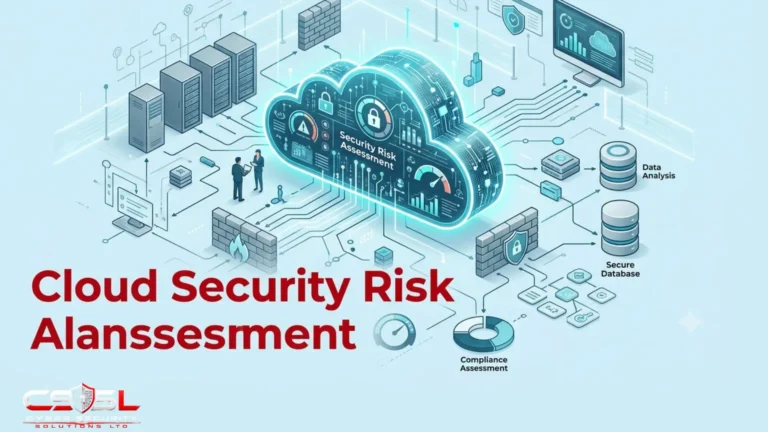
Cyber Security Solutions Ltd conducts cloud security risk assessments that map these risk categories to each organization’s specific environment and produce a prioritized remediation roadmap. See Cloud Security Risk Assessment: Step-by-Step Guide for the structured process, and Cloud Security Best Practices: The Definitive 2026 Checklist for the implementation framework.
Conclusion
These cloud computing security risks are not simply traditional threats relocated to a new environment. Misconfiguration, federated identity cascade, cloud-specific persistence, and supply chain exposure each reflect cloud architecture characteristics requiring specifically cloud-aware controls and response processes rather than on-premise thinking applied to a different location. Visit cybersecuritysolutionsltd.com for a cloud security assessment that maps these risk categories to your specific environment and identifies the gaps requiring most urgent attention.
FAQs
The main cloud computing security risks are misconfiguration exposing resources publicly, credential and identity attacks exploiting anywhere-accessibility, insecure APIs providing programmatic data access, supply chain vulnerabilities through third-party integrations, cloud-adapted ransomware targeting cloud storage and backups, and data exfiltration through legitimate cloud channels. Misconfiguration consistently ranks as the primary cause per CSA research.
Cloud misconfiguration occurs when storage buckets, databases, or identity permissions are set incorrectly or too permissively. It is common because cloud platforms expose hundreds of configuration parameters, self-service provisioning creates resources faster than review processes can follow, and misconfigurations produce no external alert unless the organization actively monitors its own configuration state continuously.
Cloud services are accessible from anywhere using only valid credentials, removing the network perimeter that previously provided a secondary barrier. Federated identity creates a structural multiplier where a single identity provider compromise cascades simultaneous access across every connected cloud service, making the identity provider the single highest-value attack target in the entire cloud environment.
Publicly exposed cloud storage, including misconfigured Amazon S3 and Azure Blob Storage containers set to public access, is among the most documented exploitation patterns, often discovered by external researchers rather than the affected organization. Insecure APIs and unpatched customer-managed IaaS operating systems and applications are also consistently targeted across all organization types.
Cloud-adapted ransomware specifically targets cloud-hosted storage for encryption, deletes cloud backups to prevent recovery, and exfiltrates data before encryption to enable double extortion pressure. This extends ransomware impact beyond on-premise systems to cloud-hosted operations and potentially removes the backup recovery option organizations typically rely on to avoid paying the ransom.
Assess each risk against three factors: likelihood given your specific cloud services and current configuration, potential business impact if exploited, and control coverage already in place. Misconfiguration and credential attacks rank highest universally across organization types. A formal cloud security risk assessment maps these categories to your specific environment and produces a prioritized remediation plan.