Remote Access Security: How to Protect Your Business from Remote Work Risks
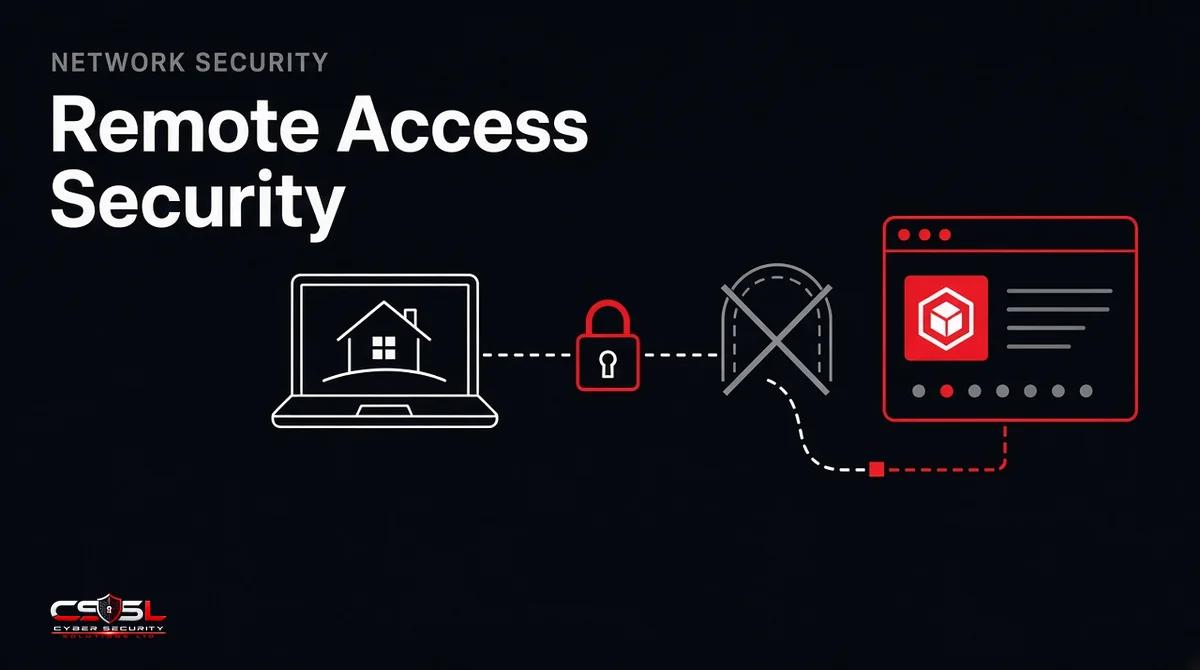
Remote access security protects the connections, identities and devices employees use to reach company systems from outside the office, and it has shifted from a VPN-centric approach to an identity-first one. If you have assumed a VPN alone still covers this risk, several major 2023 and 2024 breaches prove that assumption wrong directly.
What Is Remote Access Security and Why Is It Now Identity-First, Not Just VPN?
Remote access security covers the tools and policies governing how employees connect to company systems from outside a traditional office network, verifying identity, securing the connection itself, and limiting what a remote session can actually reach.
This has genuinely shifted from a network-centric model, where a VPN connection alone granted broad access, toward an identity-first model, where every access request gets verified individually regardless of network location. The shift happened specifically because attackers learned that a single stolen credential granting VPN access often meant broad, unrestricted network access behind it.
ZTNA vs VPN: Why the Shift Is Happening This Fast
A traditional VPN creates one encrypted tunnel granting access to an entire network segment once connected, meaning a single compromised credential can expose considerably more than the specific application an employee actually needed. Zero Trust Network Access, ZTNA, instead verifies identity and context for every individual application access request, granting only the specific resource needed rather than broad network presence.
This distinction matters directly because of how modern attacks actually unfold. A VPN breach gives an attacker a foothold inside your entire network. A ZTNA breach, by contrast, limits an attacker to only the specific application their stolen credential happened to authenticate for, considerably narrowing what a single compromise can actually reach.
Real Incidents That Show Exactly What Goes Wrong
Four recent, well-documented incidents illustrate precisely how remote access failures unfold in practice. Change Healthcare’s 2024 breach began when attackers used stolen credentials on a Citrix remote access server that lacked multi-factor authentication entirely. UnitedHealth’s own CEO testified this legacy system, acquired through a prior acquisition, had simply never had MFA enabled. Attackers moved undetected through the network for nine days, exfiltrating several terabytes of data before deploying ransomware, ultimately affecting roughly 193 million people in what became the most disruptive healthcare cyberattack on record.
MGM Resorts suffered a genuinely different failure months earlier in 2023. Attackers used social engineering specifically, a phone call to MGM’s own help desk impersonating an employee, to bypass identity verification and gain privileged access directly, causing over $100 million in business impact as slot machines, hotel check-ins and digital room keys all went dark simultaneously. Snowflake’s 2024 incident followed a similar credential-based pattern, with attackers exploiting customer accounts that had never enabled multi-factor authentication, ultimately affecting roughly 165 organizations. PowerSchool suffered a comparable compromise through a support portal credential, again illustrating the same underlying pattern across genuinely different industries: the technology itself rarely failed, remote access identity verification did.
The Technique Behind Most of Them: AiTM Session-Token Theft
Here is the specific mechanism connecting many current remote access breaches, and it explains something genuinely counterintuitive: MFA alone does not guarantee protection. Adversary-in-the-Middle, AiTM, phishing works by proxying a real login session in real time, meaning the victim genuinely enters correct credentials and completes MFA normally, believing the process worked exactly as intended.
The attacker sits invisibly between the victim and the real login page throughout this process, capturing not just the password but the session token issued after MFA successfully completes. That stolen token lets the attacker replay an already-authenticated session directly, bypassing the need to ever pass MFA themselves at all. This is precisely why simply enabling MFA, while genuinely necessary, is not sufficient on its own. Phishing-resistant authentication methods, like hardware security keys or passkeys specifically resistant to this proxying technique, close this exact gap standard app-based or SMS MFA cannot fully address.
The BYOD Governance Gap Most Companies Haven’t Closed
Many organizations allow personal devices to access company systems remotely without genuinely governing what security posture those devices must meet first. A personal laptop with outdated software, no endpoint protection, or shared family use represents a genuine, unmanaged entry point into company systems, regardless of how strong your own server-side controls are.
Closing this gap requires conditional access policies specifically checking device posture, patch status, endpoint protection presence, before granting access, rather than assuming any device successfully authenticating deserves the same trust level as a fully managed company laptop.
Why Remote Compromises Take Longer to Detect
Remote access compromises typically take longer to detect specifically because the initial activity looks identical to legitimate remote work, a login from an unfamiliar location or device does not automatically distinguish an attacker from an employee traveling or working from home genuinely. Change Healthcare’s own nine-day undetected dwell time illustrates this precisely, attackers moving through the network without triggering alerts specifically because their access pattern resembled normal remote activity closely enough to avoid immediate suspicion.
What Does This Actually Cost, and Why Do the Numbers Vary?
Remote access breach costs vary considerably because the number reflects genuinely different things depending on the source, direct incident response costs alone, versus total business disruption including lost revenue, regulatory fines and long-term remediation. MGM’s own reported $100 million figure covers immediate business impact specifically, while Change Healthcare’s ongoing costs, still climbing months after the initial breach, reflect a considerably broader, longer recovery process across an entire healthcare payment ecosystem.
The UK Angle: Why Phishing Hits UK Remote Workers Even Harder
UK remote workers face a genuinely elevated phishing risk specifically because hybrid working patterns mean employees regularly shift between home networks, public WiFi and office connections, each transition representing a fresh opportunity for a convincing, context-aware phishing attempt timed around that specific transition. NCSC’s own guidance consistently identifies phishing as the leading entry point for UK business compromises, and remote work’s inherently more varied, less monitored connection pattern compounds this risk directly compared to a fully office-based workforce.
A Realistic ZTNA Starting Point If You’re Not Ready for Full SASE
Start by identifying your highest-risk applications specifically, financial systems, customer data platforms, and apply ZTNA principles there first rather than attempting a full, organization-wide replacement immediately. Enable phishing-resistant MFA on every remote access point without exception, closing the specific AiTM gap covered earlier.
Implement basic conditional access checking device posture before granting access, even without full SASE deployment. Cyber Security Solutions Ltd helps businesses build exactly this phased approach, since a partial ZTNA rollout protecting your highest-risk systems delivers genuine, immediate risk reduction without requiring the full architectural overhaul SASE eventually represents.
Conclusion
Remote access security now depends on verifying identity for every request, not simply trusting anyone who connects through a VPN, and the incidents covered here prove exactly what happens when that verification has a gap. Start by confirming phishing-resistant MFA covers every remote access point in your own environment. To build a phased ZTNA approach for your business, visit cybersecuritysolutionsltd.com for expert support from Cyber Security Solutions Ltd.
FAQs
A VPN grants broad network access once connected. ZTNA verifies identity and context for each individual application request, granting only the specific resource needed. This limits what a single compromised credential can actually reach compared to broad VPN access.