EDR vs SIEM: How They Work Together to Protect Your Business
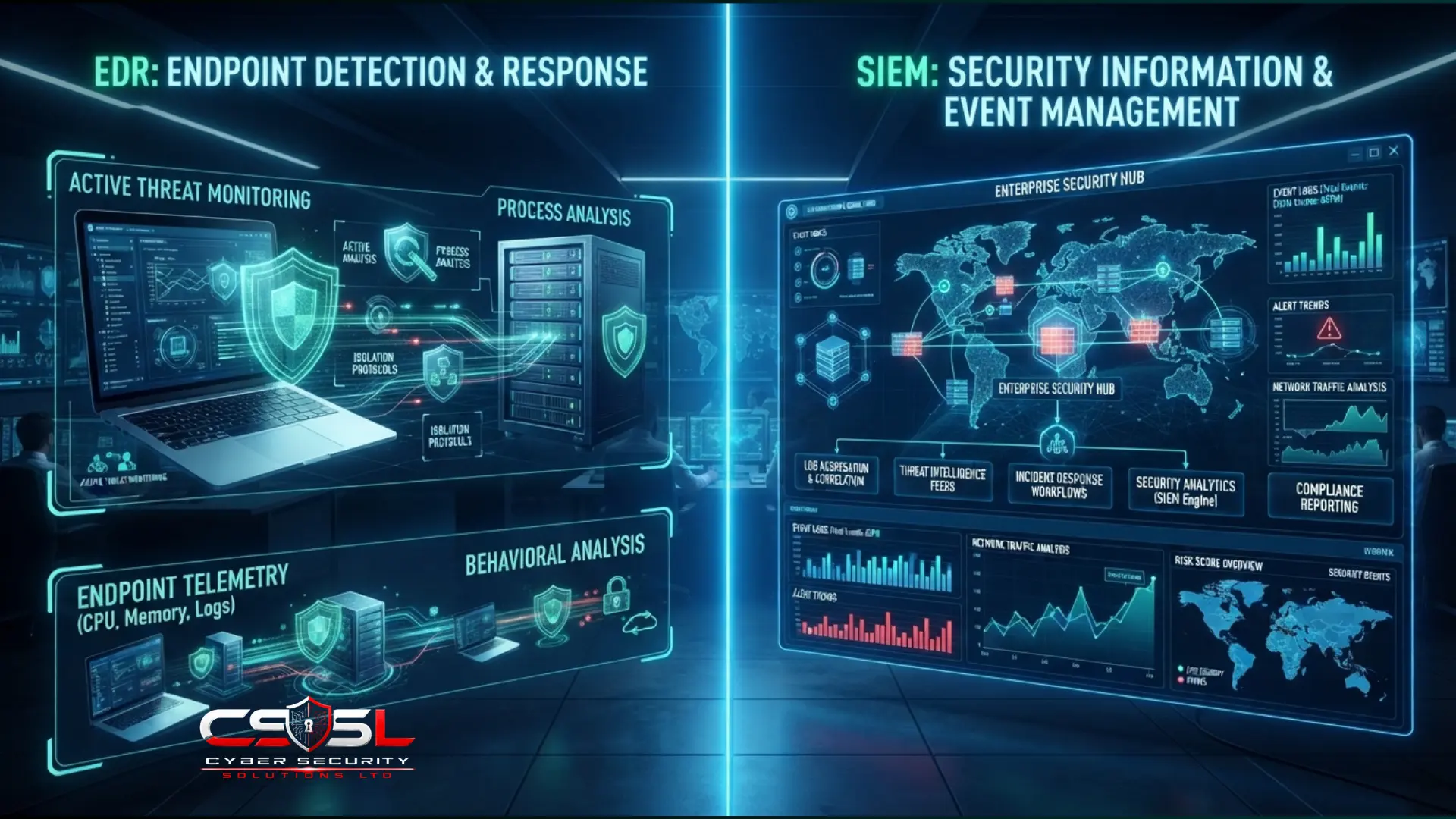
EDR monitors and responds to threats on individual endpoints specifically. SIEM correlates log data across your entire environment, network devices, applications, cloud services, alongside endpoint telemetry, giving you a network-wide picture no single endpoint view can provide alone. If you have wondered whether you need one or the other, the honest answer is they are built to work together, not compete.
What Is the Difference Between EDR and SIEM?
EDR, endpoint detection and response, monitors individual devices for suspicious behavior and enables direct investigation and response on that specific device. SIEM, security information and event management, collects and correlates log data from across your entire environment, network devices, firewalls, applications, cloud services and endpoints together, into one centralized platform for analysis.
| Criteria | EDR | SIEM |
| Data source | Endpoints specifically | Network, apps, cloud, endpoints combined |
| Primary function | Endpoint detection and response | Log correlation across sources |
| Best at | Deep endpoint context | Cross-environment pattern detection |
EDR sees deeply into one device. SIEM sees broadly across your entire environment, but relies on the individual data sources it ingests, EDR telemetry among them, to actually populate that broader picture with meaningful detail.
EDR, SIEM and SOAR: Three Terms That Get Blurred Together, Separated Clearly
These three terms genuinely describe three different functions, and conflating them causes real confusion when evaluating a security stack. EDR is a detection and response technology specifically for endpoints. SIEM is a log correlation and analysis platform spanning your broader environment. SOAR, security orchestration, automation and response, is a genuinely different layer again, automating the actual response actions a SOC team would otherwise perform manually once SIEM or EDR surfaces something requiring action.
Think of it as a sequence rather than three competing options. EDR generates detailed endpoint telemetry. SIEM ingests that telemetry alongside data from other sources and correlates it into meaningful alerts. SOAR then automates the response workflow, isolating a device, blocking an IP address, notifying the right team, once an alert crosses a defined threshold. Each layer depends on the one before it; SOAR without SIEM has nothing structured to automate a response to, and SIEM without EDR is missing the endpoint-level detail that often makes the difference between a vague, low-confidence alert and a clear, actionable one.
A Real, Worked Example: How These Two Tools Catch an Attack Together
Picture an employee’s laptop getting compromised through a phishing email. EDR on that device immediately notices unusual behavior, an unfamiliar process launching, then attempting to access credential storage locations it has no legitimate reason to touch.
On its own, this EDR alert might look like an isolated, single-device anomaly, worth investigating but not obviously part of a larger pattern. Here is where SIEM’s broader view changes the picture entirely. That same EDR telemetry, ingested into the SIEM alongside network logs, reveals that the same compromised laptop is also attempting unusual outbound connections to an external address, and, critically, that a second, unrelated device on the same network attempted a similar credential access pattern within the past hour. Neither individual EDR alert alone would have surfaced this as a coordinated pattern. The SIEM’s correlation across both the endpoint telemetry and the network-level connection logs is what reveals this is not one isolated incident but a spreading compromise, exactly the kind of pattern that determines whether a response team treats this as a routine cleanup or an active, spreading incident requiring immediate, wider containment.
Why the Gap Between Endpoint and Network Visibility Matters: The 241-Day Problem
Here is a statistic worth getting precisely right, since an outdated version of it still circulates widely. The current IBM Cost of a Data Breach Report, published in 2025, puts the average global breach lifecycle at 241 days total, 181 days to identify a breach plus 60 days to contain it, actually the lowest figure recorded in nine years, down from 258 days the year before.
This 241-day gap represents the real-world cost of exactly the visibility problem this guide has been building toward. An organization relying on endpoint telemetry alone can see that something unusual happened on one device, but without network-wide correlation, connecting that single-device signal to broader patterns across other endpoints, network traffic and cloud services, that isolated signal often sits unrecognized as part of a larger compromise for months. IBM’s own data shows this gap has real financial consequences too: breaches contained within 200 days cost organizations roughly $3.87 million on average, while those extending beyond 200 days cost $5.01 million, a $1.14 million difference directly attributable to how long a threat goes unrecognized.
A separate, telling detail from IBM’s research reinforces exactly why SIEM’s correlating role matters specifically. Breaches identified through internal detection capability, SIEM and SOC monitoring among the primary tools involved, consistently cost less than breaches only discovered when an external party, a customer, a law enforcement notification, a public disclosure, informs the organization first. This is the concrete, financial argument for exactly the EDR-to-SIEM pipeline this guide describes: endpoint telemetry alone generates isolated signals, but without the network-wide correlation SIEM provides, those signals too often go unrecognized until someone outside the organization notices first, considerably later and considerably more expensively than internal detection would have caught it.
The Honest Limitation: What EDR and SIEM Together Still Can’t See
Even a well-integrated EDR and SIEM stack carries a genuine, current limitation worth stating honestly rather than glossing over: cloud-native environments frequently sit outside the visibility both tools were originally built to cover.
EDR was designed for traditional endpoints, laptops, servers, devices with an operating system an agent can install directly onto. Many modern cloud-native workloads, serverless functions, ephemeral containers spinning up and down within minutes, managed services where you never directly control the underlying infrastructure, have no persistent endpoint for an EDR agent to install onto at all. SIEM can ingest whatever logs a cloud provider makes available, but log availability and depth vary considerably across providers and services, meaning the rich, granular telemetry EDR provides for a traditional endpoint often simply does not exist in an equivalent form for a serverless function that existed for eleven seconds before terminating.
This gap matters directly for any organization running meaningful cloud-native infrastructure alongside traditional endpoints, which describes most modern businesses to some degree. Assuming your EDR-plus-SIEM stack provides complete coverage the moment it is deployed, without specifically verifying what visibility exists into your cloud-native workloads, leaves a real, unaddressed blind spot precisely where an increasing share of your actual infrastructure now lives. Closing this gap generally requires cloud-native security tooling purpose-built for exactly this environment, working alongside, not replacing, the EDR and SIEM combination this guide has described, since neither tool alone was ever designed to fully address infrastructure this fundamentally different from a traditional, persistent endpoint.
What Does NCSC Actually Recommend?
The UK’s National Cyber Security Centre takes a deliberately technology-agnostic approach in its SOC guidance, rather than recommending any specific vendor stack or mandating a particular combination of tools. NCSC’s guidance instead focuses on the outcomes a genuinely effective security operations capability should achieve: sufficient visibility across an organization’s actual environment, the ability to correlate signals meaningfully rather than reviewing isolated alerts in a vacuum, and defined processes for escalating and responding once something genuinely suspicious surfaces.
This approach makes sense given how differently organizations of varying size and complexity actually need to implement these principles. A small business might achieve genuine visibility and correlation through a lighter-weight, managed combination of EDR and a cloud-hosted SIEM service. A larger organization with a dedicated SOC team might build a considerably more elaborate, in-house stack achieving the same underlying outcomes. NCSC’s own framing deliberately avoids prescribing which specific tools accomplish this, focusing instead on whether an organization can genuinely demonstrate the visibility, correlation and response capability its guidance describes, regardless of the specific technology choices behind it.
How Do You Actually Build This Integration?
Confirm your EDR platform genuinely supports exporting its telemetry into your SIEM, since not every EDR-SIEM pairing integrates cleanly without additional configuration or a dedicated connector. Map out what other log sources genuinely need to feed into your SIEM alongside endpoint telemetry, network devices, firewalls, cloud service logs, since SIEM’s value comes specifically from correlating across sources, not from endpoint data alone.
Define clear alert correlation rules and escalation thresholds rather than simply forwarding every raw EDR alert into the SIEM unfiltered, since an unfiltered flood of low-value alerts undermines the entire purpose of correlation in the first place. Explicitly audit your cloud-native infrastructure for the visibility gap covered above, rather than assuming your existing EDR-SIEM integration automatically extends coverage there. Cyber Security Solutions Ltd builds exactly this kind of integrated stack for clients, mapping actual telemetry sources against genuine correlation needs, rather than assuming any single tool combination automatically achieves complete visibility without deliberate configuration.
Conclusion
EDR and SIEM answer genuinely different questions, deep endpoint context versus broad environmental correlation, and the real value comes from connecting them deliberately rather than assuming either one alone provides complete visibility. Start by confirming your own EDR telemetry actually reaches your SIEM in a genuinely useful, correlated form, and honestly assess your cloud-native visibility gap. To get help building an integrated detection stack that accounts for these gaps, visit cybersecuritysolutionsltd.com for expert support from Cyber Security Solutions Ltd.